How To Do Keyword Mapping & Why It’s a Game-Changer for SEO
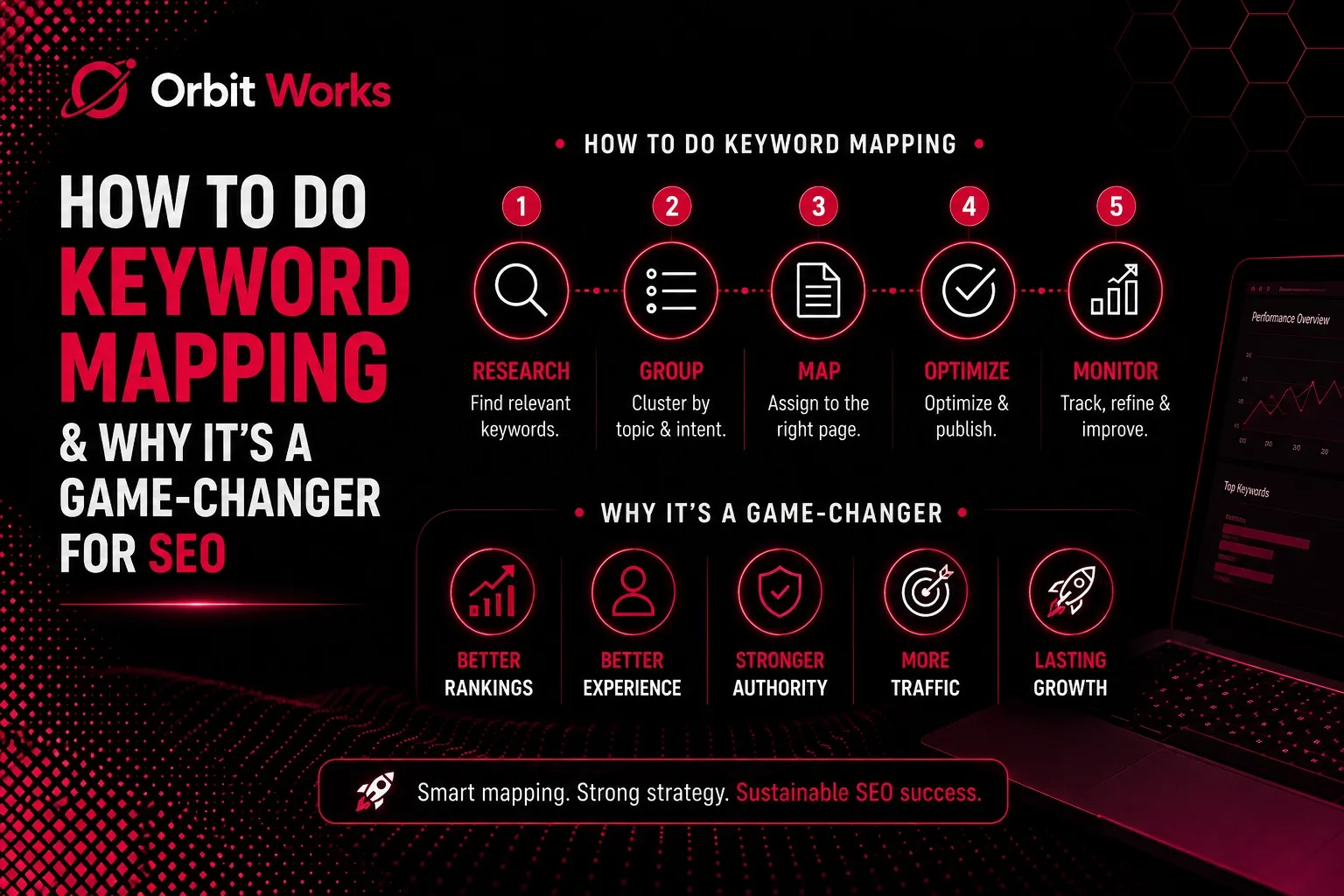
This comprehensive guide reveals the 5-step keyword mapping process, covering research, clustering, URL assignment, and on-page optimization. By implementing this strategy, you'll eliminate keyword cannibalization, improve site architecture, and attract highly targeted traffic that drives long-term organic growth.
Stop guessing which keywords you should target. Many businesses chase high-volume keywords without realizing how difficult they are to rank for. As a result, they waste time and effort with little return.
However, keyword mapping changes this approach completely. It gives you a clear and organized search engine optimization strategy. Instead of randomly choosing keywords, you identify the right ones and place them on the right pages of your website.
Even better, keyword mapping is not complicated. With the right steps, anyone can do it. In this guide, you will learn how to perform keyword mapping for your website just like SEO professionals do.
What Is Keyword Mapping?
Keyword mapping is the process of grouping related keywords and assigning them to specific pages on your website. Each group of keywords is connected to a single URL. As a result, every page has a clear purpose and a defined keyword target.
This method helps you build a strong and organized content strategy. Each page focuses on a specific topic and a set of keywords that support it. At the same time, it allows a single page to rank for multiple related keywords.
Because of this structure, your website gains better visibility in search results. Search engines can understand your content more easily, and users can find relevant information faster.
Why Is Keyword Mapping a Game-Changer for SEO?
Keyword mapping is one of the most effective strategies used by SEO experts. It simplifies content planning while improving the overall performance of your website. For this reason, many professionals consider it a powerful SEO tool.
Improved Website Structure & User Experience
First, keyword mapping improves the structure of your website. When related keywords are grouped, your content becomes more organized. Pages naturally connect, creating a logical website architecture.
As a result, users can navigate your site more easily. They quickly locate the information they need. At the same time, search engines understand how different pages relate to one another.
Reduced Keyword Cannibalization
Another important advantage is the prevention of keyword cannibalization. This issue occurs when several pages on the same website target the same keyword. When that happens, those pages compete against each other in search results.
Keyword mapping prevents this problem. Each page receives a unique set of keywords. Consequently, search engines can clearly determine which page should rank for each query.
Enhanced Search Engine Rankings
Keyword mapping also improves your chances of ranking higher in search results. Search engines use complex algorithms to understand websites. When your content structure is clear, it becomes easier for them to interpret your pages. Before keyword mapping you must know how do search engines actually work.
Moreover, mapping keywords shows how each page connects within your website hierarchy. This clarity helps search engines evaluate your content more effectively, which increases your ranking potential.
Another major benefit appears over time. If you create a detailed keyword map from the start, you will build a strong foundation for long-term success. Your keyword map will continuously provide new content ideas and keyword opportunities. As a result, you will never run out of topics to write about.
How to Do Keyword Mapping in 5 Steps
Keyword mapping is a simple and structured process. By following a few clear steps, you can create a powerful SEO framework for your website. The process begins with keyword research trends and ends with optimized content. Let’s explore each step in detail.
1. Perform Keyword Research
Keyword research is the starting point of every successful keyword mapping strategy. This step focuses on discovering keywords that are relevant to your niche and achievable for ranking.
To begin, you will need a reliable keyword research tool. These tools help you discover search terms that people actually use. They also provide valuable data such as search volume, competition level, and keyword difficulty.
Some popular tools include Semrush and Ahrefs. Semrush is widely used by experienced marketers because it offers a full range of SEO features. Ahrefs is another strong option and includes keyword research tools like Keywords Explorer.
Once you open your keyword research tool, you can start searching for ideas. For example, imagine you own a florist shop in Los Angeles. You might begin with a keyword such as “Los Angeles florist.”
After entering the keyword, adjust the country and language settings according to your target audience. Then click the search button to generate keyword suggestions.
Next, the tool will show you different options for viewing keyword ideas. You can either access all available keywords or focus on high-intent keywords. High-intent keywords are particularly valuable because they often indicate a user who is ready to buy.
For a local florist business, choosing the high-intent keyword option would be the smarter choice. These keywords have stronger conversion potential and can drive both traffic and revenue.
Once you select the analysis option, the tool will generate a detailed report. This report will display keyword suggestions, search data, and ranking insights. From here, you can begin selecting the best keywords for your website.
Pick a Primary Keyword
We currently have 765 keywords, and more than 60 of them have already been reviewed in the SERPs. This is a large number of keywords to work with. Therefore, the next step is to decide which ones are actually valuable for our content strategy.
At this stage, we begin refining the keyword list. The goal is to choose primary keywords that are both relevant to the business and realistic to rank for. In other words, the keyword should match your business goals and also be achievable.
Many people are naturally drawn to keywords with extremely high search volume. However, this approach often leads to poor results. High-volume keywords usually come with intense competition. As a result, smaller websites struggle to rank for them.
If your website does not yet have strong authority or a well-established presence, ranking for those keywords becomes very difficult. This is simply the reality of organic search in 2025.
Fortunately, there is good news. Long-tail keywords often provide better opportunities. They bring more targeted traffic and usually lead to higher conversion rates. Therefore, focusing on these keywords can be a much smarter strategy.
To discover these opportunities, tools like LowFruits make the process simple. First, open your report and apply the SD filter. Then set the maximum value to 1. SD represents the SERP Difficulty Score, which measures how difficult a keyword is to rank for. A score of 1 indicates the easiest level.
After that, click Apply to filter the results.
Next, apply the # Weak filter and set the minimum value to 2. Weak Spots represent websites with low domain authority that still rank in the top ten search results. When a keyword has at least two weak spots, it becomes easier for your content to outrank those pages.
Once again, click Apply.
Now you will see a refined list of keywords with low difficulty scores and several weak competitors. After this, sort the results by search volume. Simply click the Volume column to arrange the keywords in descending order. This helps highlight the keywords with the highest search demand.
At this point, you may notice that several keywords share the same search intent. Therefore, it becomes helpful to group them into clusters. To do this, click the Clusters tab at the top of the page. The tool will automatically group related keywords on a new screen.
In each group, the main cluster keyword becomes the primary keyword. You will find it displayed in the left column. If you are organizing your keywords in a spreadsheet, you can create a separate tab for each primary keyword.
In this example, the keyword research generated eight topic clusters. You can repeat this same process for additional keywords to discover more clusters and primary keywords. Once that is done, the next step is to populate each cluster with related keywords.
Identify Secondary Keywords
Now it is time to find the supporting keywords within each cluster. These are called secondary keywords, and they help strengthen your content around the main topic.
Fortunately, this process is very simple in LowFruits. The platform already groups related keywords for you. All you need to do is click any primary cluster keyword in the left column.
Once selected, the tool will immediately display the secondary keywords associated with that cluster. For example, the cluster built around the primary keyword “Los Angeles best florist” produced 27 related keywords.
You should repeat this step for every keyword cluster in your report. Eventually, you will build several keyword clusters that support your main topics. These clusters will later guide your content creation and optimization efforts.
Assign URLs to Each Topic Cluster
At this stage, we move into the part most people associate with keyword mapping. This is where spreadsheets become useful for organizing everything.
Traditionally, SEO guides provide spreadsheet templates to structure keyword data. However, LowFruits simplifies the process significantly. Instead of building a sheet manually, you can simply click Download from any Clusters report.
This action generates a spreadsheet with all the data already arranged for you.
Inside the document, the left column displays the clusters created from your original keyword search. In this example, the clusters were generated from the keyword “los angeles florist.”
You will also see several valuable keyword insights included in the spreadsheet. These include user intent, total search volume, the list of keywords within each cluster, and the similarity percentage compared to the main keyword.
The final step is to assign a URL to each topic cluster. You can either use an empty column or add a new column to include this information. In many cases, placing the URL column before the cluster keywords keeps the sheet organized.
Each cluster should have its own unique URL. In other words, avoid assigning the same page URL to multiple clusters. Every cluster should represent a distinct piece of content.
You can repeat this process for every keyword you research. Continue adding tabs or sheets within the same spreadsheet so all the information stays organized in one place.
Once finished, you will have a complete content map. This map clearly defines keyword targets for every topic cluster.
Optimize Your Content
This step is extremely important. After building your keyword map, the next task is to apply it to your website.
After all, the strategy should not remain inside a spreadsheet. It needs to guide how you create and optimize your content.
The focus here is on-page SEO. This practice involves improving individual web pages so they rank better in search engines. Keyword optimization plays a major role in this process.
Your primary keyword should appear in several critical areas of the page. These include the SEO title, meta description, H1 tag, subheadings, URL slug, and image optimization elements.
At the same time, secondary keywords should be placed naturally throughout the content. They work best inside subheadings, body text, and images.
By doing this, your content becomes more relevant to search engines and more helpful to readers.
Next Steps: Track Your Organic Performance
After implementing your keyword mapping strategy and optimizing your website, the work does not stop there. Monitoring performance is just as important as implementation.
Search rankings constantly change. Therefore, continuous tracking helps ensure that your SEO strategy remains effective over time.
This is where rank tracking tools become valuable. They provide clear insights into how your keywords perform in search results.
For example, the LowFruits Rank Tracker offers a simple dashboard that shows how your most important keywords rank in Google. It highlights which keywords have improved in position and which ones have dropped. It also identifies the exact URL that is ranking for each keyword.
Additionally, you can track performance trends over time by expanding any keyword in the dashboard. This helps you understand long-term progress.
With proper rank tracking, you can respond quickly to changes in the search results pages. You can identify issues that might affect rankings and make adjustments when necessary. Over time, this allows you to refine your keyword mapping strategy and maintain strong visibility in search engines.
Final Thoughts
Keyword mapping is a fundamental part of a successful SEO strategy. It brings structure and clarity to your content planning.
With a well-organized keyword map, you can create content with a clear purpose. It helps attract the right audience and improves your website’s visibility in search engines.
The best part is that anyone can implement this approach. With thoughtful planning and consistent effort, you can build an effective keyword mapping strategy and unlock the full potential of your website.
FAQs
1. What is keyword mapping in SEO?
Keyword mapping is the process of assigning specific keywords to the most relevant pages on your website. It helps search engines understand what each page is about and what searches it should rank for. A good keyword map also keeps your content organized and reduces keyword overlap.
2. How do I create a keyword map?
Start by researching relevant keywords and grouping them based on search intent and topic. Then, assign each keyword group to the existing or planned page that best matches it. Keep track of the primary keyword, secondary keywords, URL, and search intent in a spreadsheet.
3. How do I map keywords to website pages?
Match keywords with pages based on what users are actually looking for when they search. For example, informational keywords usually belong on blog or guide pages, while service-related keywords should target service pages. Each page should have one clear primary keyword and closely related secondary terms.
4. How many keywords should I target on one page?
There’s no fixed number, because it depends on the topic and search intent. Generally, focus on one primary keyword and several closely related secondary keywords that naturally fit the content. The goal is to cover the topic thoroughly rather than force a specific number of keywords onto the page.
5. How does keyword mapping prevent keyword cannibalization?
Keyword mapping helps you assign different keyword themes to specific pages instead of having multiple pages compete for the same search term. This gives each page a clear purpose and target audience. It also makes it easier to identify overlapping content before it becomes a ranking problem.