How Do Search Engines Actually Work? (2026 AEO Guide)
Wondering how search engines actually work? This guide breaks down crawling, indexing, and ranking while revealing powerful techniques of search engine optimization that drive real results.
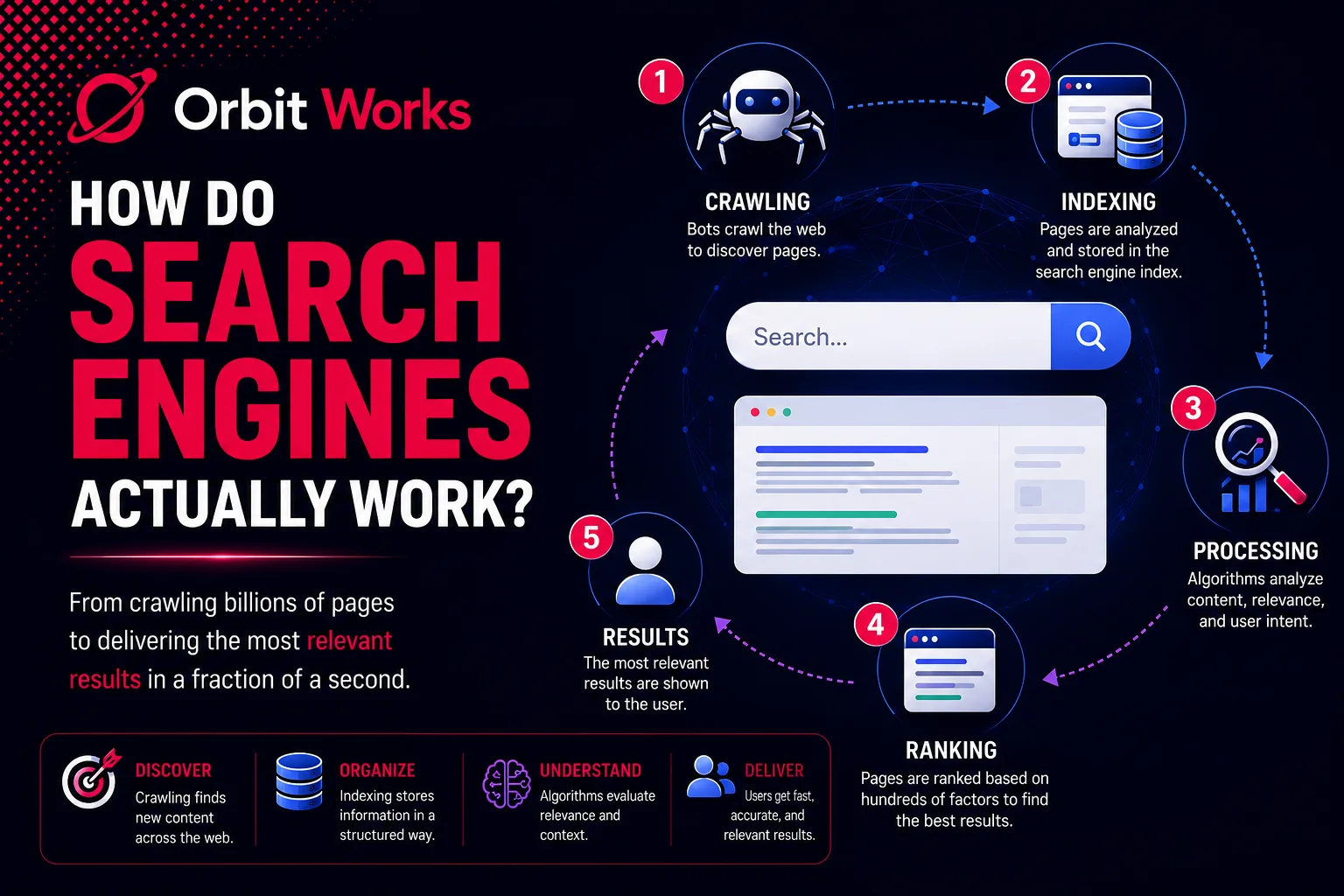
Search engines work through three core stages: crawling (discovering pages using automated bots), indexing (storing and analyzing quality content in a massive database), and ranking (ordering results based on relevance and value). They use complex algorithms that evaluate over 200 ranking factors, including backlinks, page speed, keyword usage, and user experience signals. Advanced AI systems like RankBrain and BERT help Google better understand search intent and prioritize content that genuinely satisfies users.
Pause for a second and think about how often you fire up Google to hunt for the perfect product, a quick answer, or just some inspiration. It's practically second nature.
Now imagine being on the other side, the one where people are searching for you, your brand, your site. The big question kicking off our journey is: How Do Search Engines Actually Work when deciding which websites to show and in what order?
For most searches, the magic happens through smart techniques of search engine optimization. Nail those, and you boost your visibility, pull in way more organic traffic, and watch your website become the go-to destination.
Understanding How Do Search Engines Actually Work gives you a massive advantage. It's not just about throwing content out there and hoping for the best. It's about strategically aligning with what search engines actually want. And believe me, once you grasp the fundamentals, everything else starts falling into place.
Pillars of Search Engine Optimization
If you're in digital marketing, getting your brand, website, or business discovered in search results isn't just helpful, it's essential. Staying sharp on how SEO evolves keeps you ahead of the curve and delivers real results.
Sure, Google tweaks things constantly with small updates, but the foundational pillars of search engine optimization? They've held strong since Google burst onto the scene back in the late '90s. We can break it down into three core pillars that still rule today:
Technical Optimization
Technical Optimization is all about the behind-the-scenes magic. These are the site-wide tweaks and fixes that make search engines happy without ever touching your actual content.
Think site speed, mobile-friendliness, secure connections, and crawlability. It's the invisible foundation that lets everything else shine. When you master these techniques of search engine optimization, search engines can easily discover, understand, and index your pages.
On-Page Optimization
On-Page Optimization focuses on the stuff visitors actually see and interact with. Here, you're making sure your content is super relevant, delivers an awesome user experience, and naturally weaves in the right keywords. It's where strategy meets creativity right inside your pages.
Content Management System
A CMS is the powerhouse software that lets you build, edit, and manage your entire website without needing to code everything from scratch. It's your command center for uploading or tweaking text, images, videos, and more.
The best ones also make SEO-friendly moves effortless: crafting killer page titles, writing compelling meta descriptions, setting up clean URLs, adding alt text to images, and so much more, all through a simple, intuitive dashboard.
Many modern CMS platforms come with drag-and-drop builders, so you can rearrange layouts, drop in media, and design stunning pages without ever touching code.
Some of the most popular and powerful options dominating the scene include WordPress (still the undisputed king powering the majority of sites), Shopify (ecommerce powerhouse), Wix (super user-friendly for quick builds), along with Drupal, Joomla, Squarespace, and others like Webflow or headless players such as Contentful.
Pick the right CMS, and suddenly optimizing your site for search engines feels less like rocket science and more like second nature.
Off-Page Optimization
Off-page optimization focuses on improving your website's position in search results through efforts that happen entirely outside your own site. The biggest factor in this process is backlinks. These are links from other websites pointing to yours.
Quality backlinks signal to search engines that your content is trustworthy and valuable. As more reputable sites link to you, your site's authority grows stronger over time. This is one of the most powerful techniques of search engine optimization you can invest in.
The Three Core Stages of Search Engines
Search engine algorithms are complex programs designed to understand what users really want. They analyze countless signals to deliver the most accurate and helpful results for every search.
These algorithms locate web pages across the internet and then determine which ones deserve to appear, and in what order, for specific keywords or phrases.
The entire system relies on three core stages:
Crawling
Crawling is the starting point of the whole process. Search engines use automated bots, commonly known as spiders or crawlers, to explore the web. These bots continuously discover brand-new pages while also returning to pages they already know.
When they revisit, they check for fresh content, updates, or removed sections. Crawlers move from page to page by following hyperlinks. For instance, if your homepage contains a link to a recent blog article, the crawler will follow that path and find the new post.
Website owners can choose to block certain pages from being crawled using special instructions in a file called robots.txt. When pages are blocked this way, search engines usually skip them and leave them out of search results.
Understanding this stage helps you implement better techniques of search engine optimization by ensuring crawlers can access your most important pages.
Indexing
Indexing follows crawling. In this stage, the search engine carefully evaluates every crawled page to decide whether it should be stored. If the content meets the engine's standards, it gets added to a massive database called the index.
This index functions like a giant library catalog that allows quick retrieval during searches. Pages with original, useful, and well-written content are typically included. However, several issues can prevent indexing.
These include pages that are not optimized for mobile devices, content that duplicates material already elsewhere on the web, pages filled with low-quality or spammy text, pages that could not be properly crawled due to technical errors, or pages that lack any meaningful incoming links from other sites.
Ranking
Ranking represents the final and most visible stage. Once pages have been crawled and indexed, search engines can sort them for each user query. The goal is always to present the most relevant, useful, and high-quality results at the top.
Ranking decisions happen in real time based on the exact words typed into the search bar. Over two hundred different ranking factors influence these decisions.
All of these factors generally fall into three broad SEO categories: Technical SEO, On-page SEO, and Off-page SEO. Some of the most influential signals include whether the target keyword appears in the title tag, how quickly the page loads for users, and the overall reputation of the website.
The presence of the keyword (or a close synonym) in the title tag is one clear signal. Search engines pay close attention to this because the title tag tells both users and algorithms what the page is mainly about.
Page loading speed is another major factor. Fast-loading pages create a better experience, especially on mobile devices, so search engines reward them with higher positions.
Website reputation looks at broader trust signals. It considers how authoritative and reliable the entire site appears for the topic in question, often influenced heavily by the quality and quantity of backlinks it has earned from other respected sources.
Mastering these ranking factors is central to effective techniques of search engine optimization.
Google's Algorithms
Google's primary search system is known as Google Hummingbird. It handles the process of sorting and positioning results in search engine listings.
Google includes a machine-learning component called RankBrain within its search setup. When RankBrain encounters an unfamiliar term or expression, it applies artificial intelligence to grasp the meaning more effectively.
This system translates keywords into recognized subjects and ideas. As a result, Google delivers improved outcomes, even for odd or uncommon searches.
RankBrain favors sites that deliver real user satisfaction over those simply stuffed with keywords. It prioritizes pages that match what searchers truly want.
A smart approach for SEO involves tuning your site to boost user experience and happiness. This helps you benefit strongly from RankBrain's influence.
Here are three powerful methods to achieve that:
First, target medium-tail keywords. These strike a good balance between broad and very specific terms.
Second, refine your page titles and meta descriptions to encourage clicks. When users spot your result in Google, they are more inclined to select it. Clickthrough rate measures how many viewers click your link after seeing it. Improve CTR with strong calls to action, key keyword placement, and experiments with brackets, they often perform well.
Third, craft content that extends dwell time, the duration visitors spend on your page. At the same time, lower bounce rate, the share of users who exit after just one page view.
Google's leading ranking elements include three main ones:
Links stand out, mostly referring to backlinks and external optimization efforts.
Content matters greatly, covering on-page elements and optimization.
RankBrain ranks highly as the machine-learning part that rewards strong user satisfaction.
In 2018, Google launched the BERT update. BERT improves how search engines interpret searchers' language with added focus on the surrounding context. This leads to more accurate and relevant results for users.
Modern techniques of search engine optimization must account for these AI-driven systems. The rise of AI in digital marketing has made it essential to focus on user satisfaction rather than just keyword placement.
Why User Experience Matters Now More Than Ever
Google's algorithms have become incredibly sophisticated. They don't just look at keywords anymore, they evaluate the entire user experience.
When someone lands on your page, does it load quickly? Is it easy to navigate on a phone? Does the content actually answer their question? These are the signals that determine your rankings today.
This shift means that the best techniques of search engine optimization now focus heavily on creating genuinely helpful content. It's no longer about tricking the system. It's about earning your spot by being the best answer.
Understanding what is digital marketing in today's landscape means recognizing that SEO is just one piece of a larger puzzle. Content that satisfies user intent naturally attracts backlinks, social shares, and repeat visitors, all of which boost your authority.
Practical Steps to Implement These Techniques
So, how do you actually apply all of this? Here's a straightforward approach:
Start with Technical SEO: Run a site audit to check your page speed, mobile responsiveness, and crawlability. Fix any errors that might prevent indexing.
Optimize Your Content: Research relevant keywords and incorporate them naturally into your titles, headings, and body text. But remember, write for humans first, search engines second.
Build Quality Backlinks: Guest post on reputable sites, create shareable resources, and reach out to industry influencers. Every quality backlink strengthens your authority.
Monitor Your Performance: Use tools like Google Search Console to track your rankings, clicks, and impressions. Adjust your strategy based on what the data tells you.
These core techniques of search engine optimization will set you on the right path. And if you need expert help, professional SEO services in USA can accelerate your results significantly.
Conclusion
Search engines like Google work through three core stages: crawling (discovering pages via bots), indexing (storing and analyzing quality content), and ranking (ordering results based on relevance and value).
The process relies on three main SEO pillars, Technical, On-Page, and Off-Page optimization, along with signals like backlinks, page speed, keyword usage, and user experience.
Advanced systems such as RankBrain and BERT help Google better understand queries and prioritize content that genuinely satisfies users. Mastering these fundamentals, combined with choosing an SEO-friendly CMS, drives organic visibility, traffic, and long-term growth.
The most effective techniques of search engine optimization evolve with these changes. By staying informed and adapting your strategy, you can maintain strong rankings regardless of algorithm updates.
Consider building your content around a topic cluster model. This approach groups related articles around a central pillar page, signaling deep expertise to search engines and improving your overall authority.
Stay updated on emerging keyword research trends to ensure your content aligns with what people are actually searching for. And if managing all of this feels overwhelming, partnering with experienced providers of digital marketing services in usa can give you the competitive edge you need.
Frequently Asked Questions (FAQs)
1. What are the main techniques of search engine optimization?
The core techniques of search engine optimization include Technical Optimization (site speed, mobile-friendliness, crawlability), On-Page Optimization (content quality, keyword usage, meta tags), and Off-Page Optimization (building quality backlinks). Together, these form the foundation of any successful SEO strategy.
2. How do search engines actually work in simple terms?
How Do Search Engines Actually Work? They use automated bots to crawl and discover web pages, store them in a massive index, and then rank them based on relevance and quality signals. This entire process happens in milliseconds every time you type a search query.
3. Why is user experience important for SEO?
User experience signals like page speed, mobile-friendliness, dwell time, and bounce rate directly influence rankings. Google's RankBrain and BERT algorithms prioritize pages that satisfy user intent, making UX a critical component of modern techniques of search engine optimization.
4. What role does AI play in search engines today?
AI in digital marketing has transformed search through systems like RankBrain and BERT. These AI components help Google understand search context, interpret natural language, and rank content based on genuine user satisfaction rather than just keyword matching.
5. How can I improve my search engine rankings?
Start by mastering the core techniques of search engine optimization: optimize your technical foundation, create high-quality content that answers user questions, and build authoritative backlinks. Regularly track your performance and adapt to emerging keyword research trends.
6. Should I hire professionals for SEO?
If you're short on time or expertise, professional SEO services in USA can accelerate your results. Similarly, comprehensive digital marketing services in usa often include SEO as part of a broader strategy that covers content, social media, and paid advertising.