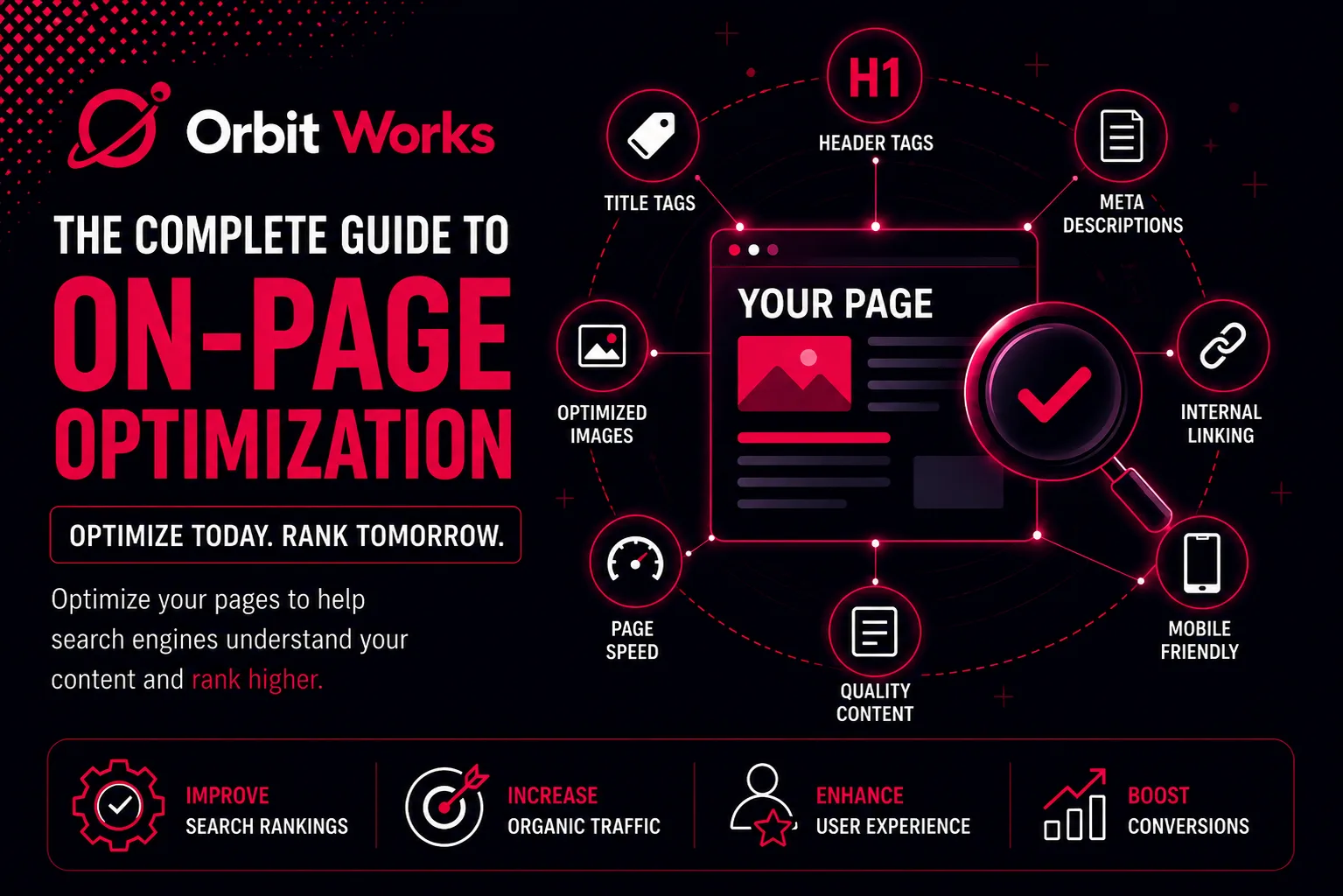
The Complete Guide to On-Page Optimization
On‑page SEO has evolved from keyword stuffing to a user‑first strategy. This complete guide covers title tags, meta descriptions, URLs, headings, and more to help you rank higher and satisfy searcher intent.
Let’s be real for a second. In the early days of SEO, on‑page optimization was basically a race to see who could cram the most keywords into a single page. It was messy, it was spammy, and honestly, it created a terrible experience for anyone actually trying to read something.
Fast forward to today, and the rules of the game have changed completely. Modern on‑page SEO focuses on making your content genuinely relevant while delivering a smooth, enjoyable user experience. It’s no longer about tricking search engines; it’s about helping them understand your content so they can serve it to the right people.
If you’re just starting out, you might first ask, what is digital marketing? At its core, it’s the practice of promoting products or services through online channels, and on‑page SEO is one of its most critical pillars. It’s the foundation that helps your website get found by the people who are actually looking for what you offer.
Today, effective on‑page optimization uses intelligent keyword placement. Keywords appear naturally in important places, the content remains readable, and most importantly, it truly meets user needs. Updates happen directly in your Content Management System (CMS), which means even non‑technical users can make changes easily. With a modern CMS like WordPress, targeting keywords becomes straightforward. Key areas to focus on include images, headings, main text, meta descriptions, and title tags.
Several free tools can help you check these elements. Tools like SEOptimer, SEO SiteCheckup, and MozBar quickly scan a page’s HTML and highlight critical optimization factors. This lets you see if your page meets standards or needs improvement. MozBar, a browser extension from Moz, works on both Chrome and Firefox and displays key details like the URL, page title, meta description, meta keywords, and H1 heading right from the search results page.
Pre‑Click and Post‑Click Optimization
Before we dive into the individual elements, it’s helpful to understand that on‑page SEO splits into two main types: pre‑click and post‑click optimization.
Pre‑Click Optimization covers everything a user sees before they click on your result in the search engine results page (SERP). This includes your title tag, URL, and meta description. The main purpose here is to attract clicks. Strong pre‑click optimization encourages users to select your result over the competition, and it also supports RankBrain signals for better organic rankings.
Post‑Click Optimization, on the other hand, kicks in after the user lands on your webpage. These are the elements that actually deliver the value, your primary content, main heading, subheadings, internal links, and images. The focus here is on keeping visitors engaged and ensuring the page delivers exactly what they expected when they clicked.
Title Tags
Title tags rank as the second most critical on‑page elements, right after your main content. They’re the first thing users notice in search results, and search engines give strong weight to the words you use in them. That directly affects your page’s ranking position.
In Chrome, you can check a page’s title tag easily. Just right‑click anywhere on the webpage, select "View page source," and look for the line that starts with <title>. For example, it might show <title>Corporate Training | Digital Marketing Institute</title>.
Title tags play a key role in on‑page SEO. They carry major importance as a ranking factor and serve as the top location for placing keywords. Pages with well‑optimized titles often achieve higher rankings. The title displays as that blue, clickable link in search results, it’s literally the very first element a searcher encounters.
Practical tips for writing great title tags:
Place your primary and secondary keywords in the title.
Position the most important keyword toward the start.
Follow this proven format: Primary Keyword – Secondary Keyword – Brand Name.
Never stuff keywords excessively, it looks spammy and turns people off.
Respect the character limit. Desktop and mobile displays show different lengths, so always check current best practices. Tools like the Portent SERP Preview Tool can help you create properly sized titles.
Write descriptive and clickable titles. Use natural wording that explains the page content clearly. Click‑through rate (CTR) influences RankBrain signals, so make it irresistible.
Use separators like pipes (|) or dashes (–) for clarity, and add your brand name at the end when space allows.
Keep in mind that sometimes Google rewrites title tags automatically in search results, so the more accurate and relevant you make yours, the less likely that becomes.
Meta‑Descriptions
Meta description tags appear only in search engine results pages and in your page source code, they stay hidden when you view the actual webpage content. This tag is the brief descriptive text shown right below the URL in search listings.
While meta descriptions don’t act as a direct ranking factor in search algorithms, they strongly affect whether users decide to click your result. They serve as a medium‑strength on‑page SEO signal that motivates searchers to visit your page. When a meta description includes a term from the user’s query, search engines bold that text. This bolding draws attention and increases click‑through rates.
Sometimes Google creates its own meta description for a page if yours is missing, too long, or not relevant enough. You can improve yours to reduce the chance of Google overriding it.
Best practices for meta descriptions:
Keep it short. Limit it to two short sentences at most. On desktop, aim for a maximum of around 156 characters, and on mobile, stay under about 115 characters. Use a SERP preview tool to check how it displays.
Be careful with your keywords. Your title tag likely already contains several keywords. Repeating them all in the meta description risks keyword stuffing. Since keywords here don’t directly help rankings, focus only on your primary keyword, this one is most likely to get bolded in results.
Be descriptive and engaging. Craft a meta description that clearly explains the page content and highlights any unique selling points to stand out and encourage visits.
URLs
URL stands for Uniform Resource Locator, it’s simply another name for a web address. URLs appear between the title tag and the meta description in a page’s code. Over time, a webpage gains trust and authority, and that value gets linked directly to its URL. If you change a URL without proper redirects, the page can lose that built‑up trust and authority. For this reason, it’s smarter to create good URLs from the very beginning.
Why are URLs important? They act as light‑weight on‑page SEO signals that help draw more clicks from search engine results. Search engines also rely on URLs to find, index, and retrieve pages quickly. A clear URL supports better visibility and user engagement.
Most of the time, URLs come from the page’s main heading. This works well by default because it adds natural relevancy between the content and the address. However, headings can produce URLs that are too long and often repeat words unnecessarily. In such cases, you should shorten the URL for better results.
Best practices when creating a URL:
Include your primary keyword or a very close variation.
Keep the URL short and clear, aim for around 70 characters or fewer before search engines start cutting it off.
Decide and set the final URL early in the process.
Use dashes to separate words.
Always choose lowercase letters.
For example, for a page titled "The Complete Guide to On‑Page Optimization," you could use either /on-page-optimization-guide or /seo/on-page-optimization. Both formats perform equally well for SEO and offer roughly the same level of relevancy to search engines.
Headings
Headings, main body text, and images form the core elements that drive strong on‑page optimization after a user clicks through. Headings give a clear structure to your webpage. They work much like headings in Microsoft Word, place the primary title inside an H1 tag, use H2 tags for secondary sections, H3 tags for third‑level subsections, and continue this pattern up to H6 tags if needed.
In the past, experts viewed multiple H1 tags as poor practice. That’s why many still suggest using just one H1 for the main title. Since HTML5 arrived, search engines accept multiple H1 tags without penalty, but the classic hierarchical method remains the safest and most widely recommended best practice.
Headings play a vital role on any webpage. Most users quickly scan headings first and decide whether to read further based on what they see. Headings carry medium importance as an on‑page SEO factor and boost the page’s overall relevancy.
How to structure your headings:
Keep the main title wrapped in an H1 tag.
Place secondary subheadings inside H2 tags.
Use H3 through H6 tags for deeper subsections when needed.
When you craft headings, focus first on making them useful and clear for readers, not just for search engines. At the same time, weave in your primary, secondary, and tertiary keywords naturally. The secret lies in smooth, natural placement rather than keyword stuffing.
Hyperlinks
Hyperlinks play a key role in on‑page SEO. They benefit the pages you link to and influence how search engines view your site. The method you use for internal linking strongly affects search rankings.
Relevance: When you link to other pages using clear and descriptive anchor text, you pass stronger relevance signals to those pages. Connect regularly to your most important content to boost its topical strength. This is also a great place to implement a topic cluster strategy, where you group related articles around a central pillar topic. By internally linking your cluster content back to the pillar page, you improve search visibility and site authority.
Reputation: Internal links also build the perceived importance of a page. Pages that receive many internal links appear more valuable to search engines and gain a better opportunity to rank higher.
Images
Image optimization serves as a simple yet effective on‑page SEO signal that increases the overall relevance of your webpage. Adding alt text to every image is essential, screen readers use this text for visually impaired users, and search engines read alt text carefully. This creates an excellent chance to include relevant keywords naturally.
How to optimize images effectively:
Alt Text: Include descriptive alt text directly in your CMS. Aim to describe the image accurately and include important keywords when they fit naturally. Keep it short, usually between two and five words.
Filenames: Assign meaningful filenames in your media library. Choose concise names, typically two to five words long. Filenames and alt text can match, though they don’t have to be identical.
File Format and Size: Ensure images are web‑friendly by using formats like .gif, .jpeg, .png, or .svg. SVG files are growing in popularity because they offer scalable vectors with sharp quality at low file sizes, perfect for logos and icons. Compress images to keep file sizes low and prevent slow loading times.
Above all, prioritize descriptive and accurate alt text and filenames. Add keywords only as a secondary step. For example, on a page about on‑page optimization, you could use alt text like “on page optimization” paired with a filename such as “optimization-measurement.jpg” for added relevance.
User Satisfaction Optimization
User satisfaction optimization forms a crucial element of on‑page SEO. It connects directly to Google’s RankBrain system, which heavily relies on AI in digital marketing to analyze user behavior, interpret search intent, and deliver more accurate search results. The goal is to make your website deliver exactly what searchers want.
To understand why this matters, it helps to first understand How Do Search Engines Actually Work. They use complex algorithms to crawl, index, and rank pages based on relevance and authority. But more than that, they track how users interact with your content. Signals like bounce rate, dwell time, and click‑through rate tell search engines whether your page is satisfying the user’s query. When visitors stay longer, engage deeply, and find quick solutions, search engines notice and reward the content accordingly.
Focus on metrics that reflect positive user experiences, lowering bounce rates, extending dwell time, raising click‑through rates, and helping users complete their intended tasks more easily. When you align your content with user intent, you’re not just optimizing for algorithms; you’re optimizing for real people.
Conclusion
Effective on‑page SEO has evolved from outdated keyword stuffing to a user‑first strategy that naturally integrates keywords while prioritizing readability and value. Key elements, optimized title tags, meta descriptions, clean URLs, structured headings, descriptive image alt text, strategic internal links, and fast‑loading pages, work together to boost relevance, attract clicks, and improve rankings.
Ultimately, the strongest on‑page SEO aligns perfectly with user intent, enhancing satisfaction metrics like dwell time and low bounce rates. This signals quality to search engines (especially RankBrain), driving better organic performance and sustained visibility.
If you’re feeling overwhelmed, remember that help is available. Many businesses rely on professional SEO services in the USA or digital marketing services in usa to handle the heavy lifting. And don’t forget to stay updated on the latest keyword research trends, they’ll help you discover the terms your audience is actually searching for, so you can build your content strategy around real demand.
Frequently Asked Questions (FAQs)
1. What are on‑page optimization examples?
On‑page optimization includes improving title tags, meta descriptions, headings, URLs, images, and internal links. It also means placing keywords naturally, creating useful content, and making pages mobile‑friendly. These changes help search engines understand your page and improve the visitor experience.
2. What are on‑page optimization techniques?
On‑page optimization techniques are methods used to improve a webpage’s visibility in search engines. These include optimizing keywords, writing clear titles, improving page speed, using proper heading structure, and adding image alt text. Good on‑page SEO also focuses on content quality and user experience.
3. What is SEO page optimization?
SEO page optimization is the process of improving a webpage so it ranks better in search results. It involves optimizing content, HTML elements, images, and internal links to make the page more relevant and user‑friendly. The goal is to increase organic traffic and engagement.
4. What is on‑page SEO for images?
On‑page SEO for images means optimizing image filenames, alt text, size, and format to improve search visibility and website speed. Well‑optimized images help search engines understand the content while improving accessibility for users. Smaller image sizes also support faster page loading.
5. What is on‑page SEO, and why is it important?
On‑page SEO is the practice of optimizing webpage content and elements like titles, headings, and images to improve search rankings. It is important because it helps search engines understand your content and provides a better experience for visitors. Strong on‑page SEO increases traffic, visibility, and conversions.
6. What are the types of on‑page SEO?
The main types of on‑page SEO include content optimization, technical optimization, image optimization, and HTML optimization. This covers keyword usage, title tags, meta descriptions, internal links, page speed, and mobile responsiveness. Each type helps improve rankings and user experience.
7. What are on‑page and off‑page SEO strategies?
On‑page SEO strategies focus on optimizing website content, keywords, headings, images, and technical elements within the site. Off‑page SEO strategies involve activities outside the website, such as backlink building, social sharing, and brand mentions. Together, they improve search rankings, authority, and organic traffic.