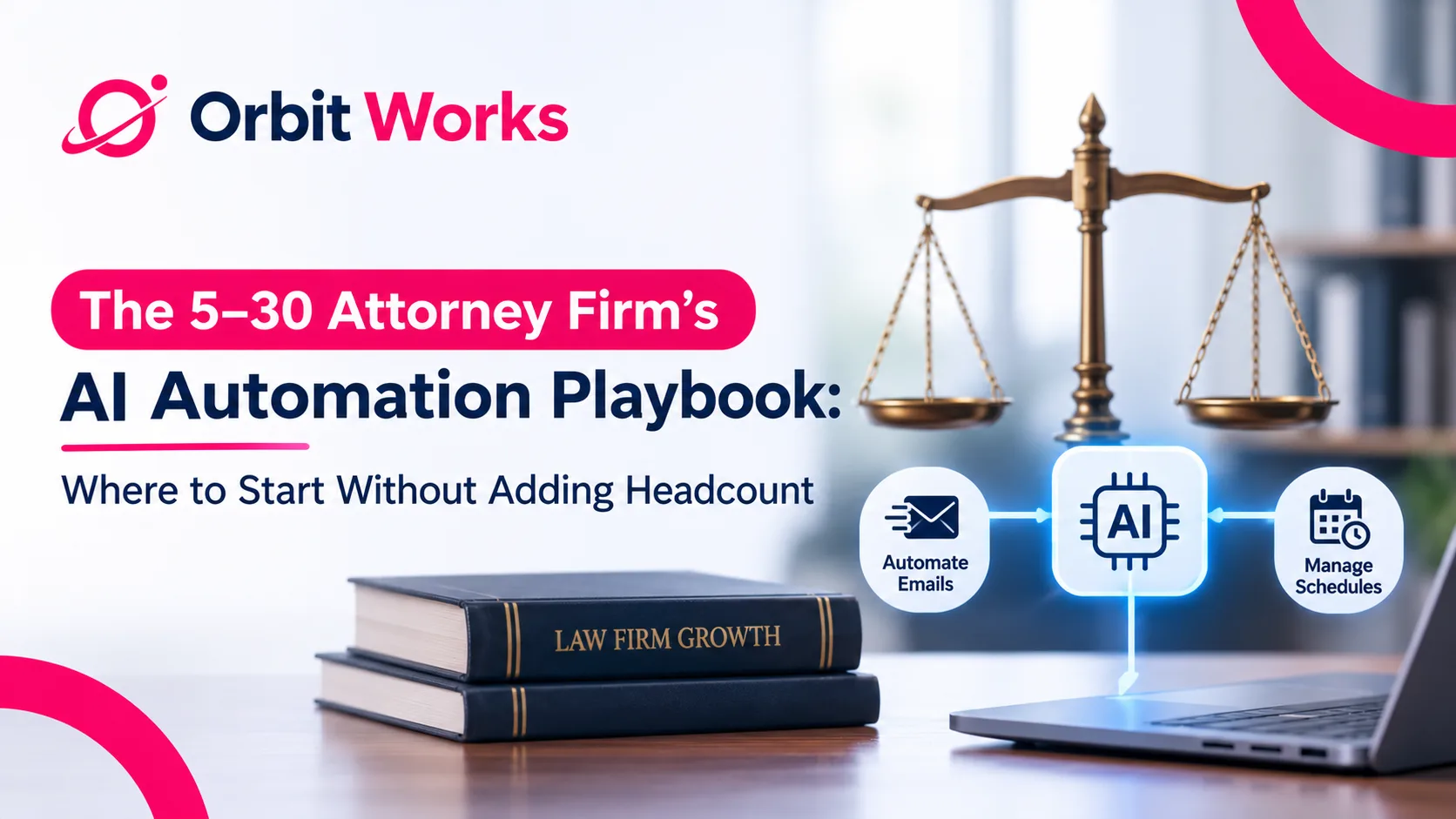
The 5–30 Attorney Firm's AI Automation Playbook: Where to Start Without Adding Headcount
Small law firms are adopting AI nearly twice as fast as they were two years ago, yet most still run automation in scattered experiments rather than a deliberate operating system. This playbook gives managing partners and firm administrators a sequenced starting point: the three workflows that pay back fastest, the ethical guardrails that cannot be skipped, and a build-versus-buy framework for firms that need implementation capacity they do not have in-house.
AI adoption among small law firms and solo practitioners nearly doubled between 2023 and 2025, rising from 27% to 53% as firms moved to automate routine tasks and protect billable capacity. Yet the same body of research shows that only 8% of solo practitioners and 4% of small law firms describe their AI use as widespread or universal. The gap between "we tried a tool" and "automation is part of how the firm operates" is where most 5–30 attorney practices get stuck.
That gap is not a technology problem. It is a sequencing problem. Firms that start with the wrong workflow, skip the governance step, or buy a platform before mapping the process end up with partial adoption that adds complexity without removing work. This playbook is the sequence that works: where to start, what to leave alone, and how to decide whether to build the workflow in-house or bring in an implementation partner.
Why small firms are the right size for automation
The economics of a 5–30 attorney firm make automation unusually high-leverage. Every hour a partner or paralegal spends on intake follow-up, document assembly, or billing reminders is an hour not spent on the work only a lawyer can do. When a solo practitioner connected his practice management system to an AI workflow layer, he reported producing roughly five times his prior output without adding staff. A six-lawyer San Francisco litigation firm that chose not to replace a departing associate leaned on AI instead; staffing costs fell 27% and profits rose, even while the firm billed fewer hours.
The capacity effect is measurable across the market. In a 2026 Total Economic Impact study of small firms using Thomson Reuters CoCounsel Legal, respondents increased average monthly matter capacity from 10.5 to 18.6—a 77% increase without a new hire, and the modeled payback period was under six months. Those results do not require an enterprise budget. They require picking workflows where legal judgment is low and manual repetition is high.
The competitive logic is just as direct. Referrals still drive most small-firm growth, but firms that pair referrals with digital intake tools report materially higher revenue: solo firms using e-signatures, intake forms, and schedulers saw 53% higher revenue, and small firms saw a 28% increase. Automation is not a cost center. It is a growth channel that happens to reduce administrative drag.
The ethical guardrails that cannot be skipped
No automation rollout survives contact with a malpractice carrier or a disciplinary committee if the ethics layer is missing. ABA Formal Opinion 512, issued in July 2024, applies existing Model Rules to AI use across six areas: competence, confidentiality, communication, candor toward tribunals, supervisory responsibilities, and fees. The opinion requires attorneys to understand the capabilities and limitations of the tools they use, conduct vendor due diligence on confidentiality and data retention, supervise AI-assisted work products, and maintain a written governance policy.
For a small firm, the compliance burden is real but not unmanageable. A one-page written policy is sufficient: identify the approved tools, state what client information may and may not be entered, and describe how AI output is reviewed before it leaves the firm. Vendor due diligence can be treated as a contract review exercise, reading the terms of service for whether the vendor trains on inputs, whether there is an opt-out, how long data is retained, and who can see it. The supervision standard is the one most solos already apply to a capable but unlicensed law clerk: review every citation, confirm every factual assertion, and edit until the language is the firm's own.
The risk of skipping this step is not theoretical. Mata v. Avianca was a small-firm failure, not a BigLaw one: an attorney submitted AI-generated citations without verification and faced sanctions. Malpractice carriers are now asking about AI use on renewal applications and, in some cases, conditioning coverage on a documented policy. Governance is the first automation deliverable, not the last.
Where to start: three workflows, in order
The firms that get traction do not begin with the most exciting AI capability. They begin with the workflow that is repetitive, measurable, and low-judgment, then expand only after the first workflow is stable.
1. Client intake and conflict-check routing
Client intake is the most common first automation project because it is easy to automate, pays off quickly, and disrupts little. It is also the entry point for every matter. A proper intake automation connects the web form to the practice management system, triggers the conflict-check sequence, sends the engagement letter, and creates the task assignments, without a partner manually re-keying the same information into three systems.
The measurable outcome is speed-to-lead and conversion. Firms using digital intake tools alongside referrals see stronger revenue growth and higher conversion, and the workflow is contained enough that a failed experiment does not touch substantive legal work. This is the workflow to automate before anything else, because it unlocks clean data for every downstream automation.
2. Document assembly for first drafts
Document automation is the second highest-leverage workflow for most 5–30 attorney firms. The goal is not to let AI draft the final work product. The goal is to eliminate the blank-page problem for engagement letters, standard agreements, routine filings, and first-pass discovery drafts that a lawyer would otherwise spend hours assembling from precedent.
Ad Astra Law Group's managing partner described the shift plainly: a complaint that used to take two days to draft took two and a half hours, and the firm used the recovered capacity to produce more thorough filings under tight deadlines. The practical rule is to keep the lawyer's review firmly in place. Automated first drafts are valuable because they are faster to edit than to create, not because they are ready to file.
3. Billing follow-up and time-capture recovery
Billing automation is the most avoided workflow in small firms, and the one that recovers revenue the firm has already earned. Automating invoice delivery, payment reminders, and time-entry prompts does not change the legal work, but it shortens the cash cycle and reduces the administrative leakage that quietly erodes profitability.
The sequencing matters. Firms that automate billing before intake and document assembly end up automating a process they have not yet standardized. Billing automation works best once matter data is clean and engagement terms are captured consistently at intake.
Build versus buy: the honest decision for a 5–30 attorney firm
Most small firms do not need to build custom AI infrastructure. They need a small number of workflows that connect the tools they already use. The build-versus-buy question is therefore less about technology and more about where the firm's time and tolerance for maintenance sit.
But when the need is well-defined, the vendor has legal-specific security and audit trails, and the firm lacks the internal capacity to configure and maintain the workflow. Purpose-built legal platforms shorten time to value, include compliance features, and shift maintenance to the vendor. For a firm with no dedicated IT or operations staff, this is often the rational first move.
Build when the workflow is genuinely firm-specific, a proprietary intake scoring model, a custom document-assembly logic tree, or an integration between systems the vendor does not support. Custom builds give the firm ownership and control, but the direct cost is low only because the time cost is high: someone has to maintain prompts, updates, and audit trails.
The most common mistake is neither building nor buying well. It is buying a platform before mapping the process, then discovering that the firm is automating an inconsistent intake routine or a document workflow that no one has documented. The right order is process first, tool second. If the process is clean and the firm lacks the hours to configure the integration, an implementation partner is the third option: not a platform subscription and not a DIY project, but a scoped build that connects existing systems and hands the firm a working workflow.
The rollout pitfalls that sink small-firm automation
Most failed rollouts are not software failures. They are adoption and sequencing failures.
Automating a broken process. If intake was inconsistent before automation, it will be inconsistently automated after. Map the current workflow and standardize it before configuring a tool.
Partial adoption with no shared standard. In a small firm, partial adoption is often worse than no adoption at all. One attorney uses the intake automation, another routes around it, and the firm ends up with more complexity and less confidence in the data. Pick one workflow, train everyone on it, and do not run parallel manual and automated processes indefinitely.
Skipping the supervision record. AI output reviewed only casually is a disciplinary risk, not an efficiency gain. Build the review checkpoint into the workflow so that a human signature is structurally required before anything leaves the firm.
Measuring activity instead of capacity. The point of automation is not to use the tool. It is to recover hours for client work, business development, or simply a sustainable week. Track matters per month, time-to-engagement, and days-to-invoice, not logins or prompts.
A 90-day starting sequence
Days 1–30: Govern and map. Write the one-page AI policy. Complete vendor due diligence on any tool that touches client data. Map the intake workflow end to end, including every handoff and every system of record. Do not buy anything yet.
Days 31–60: Automate intake. Configure the intake-to-conflict-check-to-engagement-letter path. Set a measurable baseline: current time-to-first-response, current conversion rate from inquiry to signed engagement. Run the automation in parallel with the manual process for two weeks, then retire the manual path.
Days 61–90: Add document assembly and billing follow-up. Start with the two or three documents the firm produces most often. Keep the lawyer's review checkpoint explicit. Layer in invoice delivery and payment reminders once intake data is clean. Review the results against the 30-day baseline and decide whether to expand, adjust, or stop.
The firms that succeed at this do not automate everything at once. They automate one workflow completely, prove the capacity gain, and use that credibility to fund the next one. That is how a 5–30 attorney firm adds capability without adding headcount—and without adding a failed rollout to the list of reasons automation "does not work here."
Ready to build the first workflow?
If your firm has mapped the process but does not have the internal hours to configure the integration, OrbitWorks works with 5–30 attorney firms to scope and build the intake, CRM, and document workflows that connect the tools you already use. We are not a platform subscription and we are not a DIY template, we are the implementation partner for firms that have decided what to automate and need it built correctly, with the supervision checkpoints and audit trail your malpractice carrier will ask about.
Start with the workflow that pays back fastest. Contact OrbitWorks about a scoped intake AI automation building services.
FAQs
What should a 5–30 attorney firm automate first?
Start with client intake and conflict-check routing. It is repetitive, low-judgment, and touches every matter, so clean intake data powers every downstream automation. Connect the web form to your practice management system, trigger conflict checks, send the engagement letter, and assign tasks. Automate intake before document assembly or billing, because those workflows depend on consistent matter data captured at the front end.
Is AI automation safe for client confidentiality in a small law firm?
It can be, if you treat vendor due diligence as a contract review exercise. Confirm whether the vendor trains on your inputs, whether there is an opt-out, how long data is retained, and who can access it. ABA Formal Opinion 512 requires competence, confidentiality, and supervision. Adopt a one-page written policy identifying approved tools and prohibiting client data entry into unapproved systems. Governance is the first deliverable, not the last.
How much does AI automation cost for a 5–30 attorney firm?
Costs range from low monthly subscriptions for intake and document tools to scoped implementation projects for custom integrations. The larger cost is often internal time: mapping workflows, configuring systems, and training staff. Firms that automate one workflow completely usually recover the investment through faster intake conversion, reduced administrative hours, and shorter billing cycles. Model payback in months, not years, and measure capacity recovered rather than tool logins.
Do we need a written AI policy before using automation tools?
Yes. A one-page policy is sufficient for most small firms. It should identify approved tools, state what client information may and may not be entered, and describe how AI output is reviewed before it leaves the firm. Malpractice carriers increasingly ask about AI use on renewal applications, and ABA Formal Opinion 512 expects documented supervision. The policy does not need to be elaborate, but it must exist and be followed consistently.
Should a small firm build its own automation or buy a platform?
But when the need is well-defined, the vendor offers legal-specific security and audit trails, and your firm lacks internal capacity to configure and maintain the workflow. Build when the workflow is genuinely firm-specific, such as proprietary intake scoring or custom document logic. The most common mistake is buying a platform before mapping the process. Standardize the workflow first, then choose the tool or implementation partner.
How long before a small law firm sees ROI from AI automation?
Most firms see measurable results within one to three months when they automate intake first. Set a baseline before configuring anything: time-to-first-response, inquiry-to-engagement conversion, and days-to-invoice. Run the automation in parallel with the manual process for two weeks, then retire the manual path. Firms that automate one workflow completely before expanding typically recover capacity faster than firms that spread experiments across multiple tools.