AI-Powered Marketing Agencies in 2026: Complete Guide
AI doesn't replace marketers, it amplifies them. The agencies seeing the best results in 2026 are those that use AI to handle data complexity while letting human strategists focus on creativity, brand building, and customer relationships.
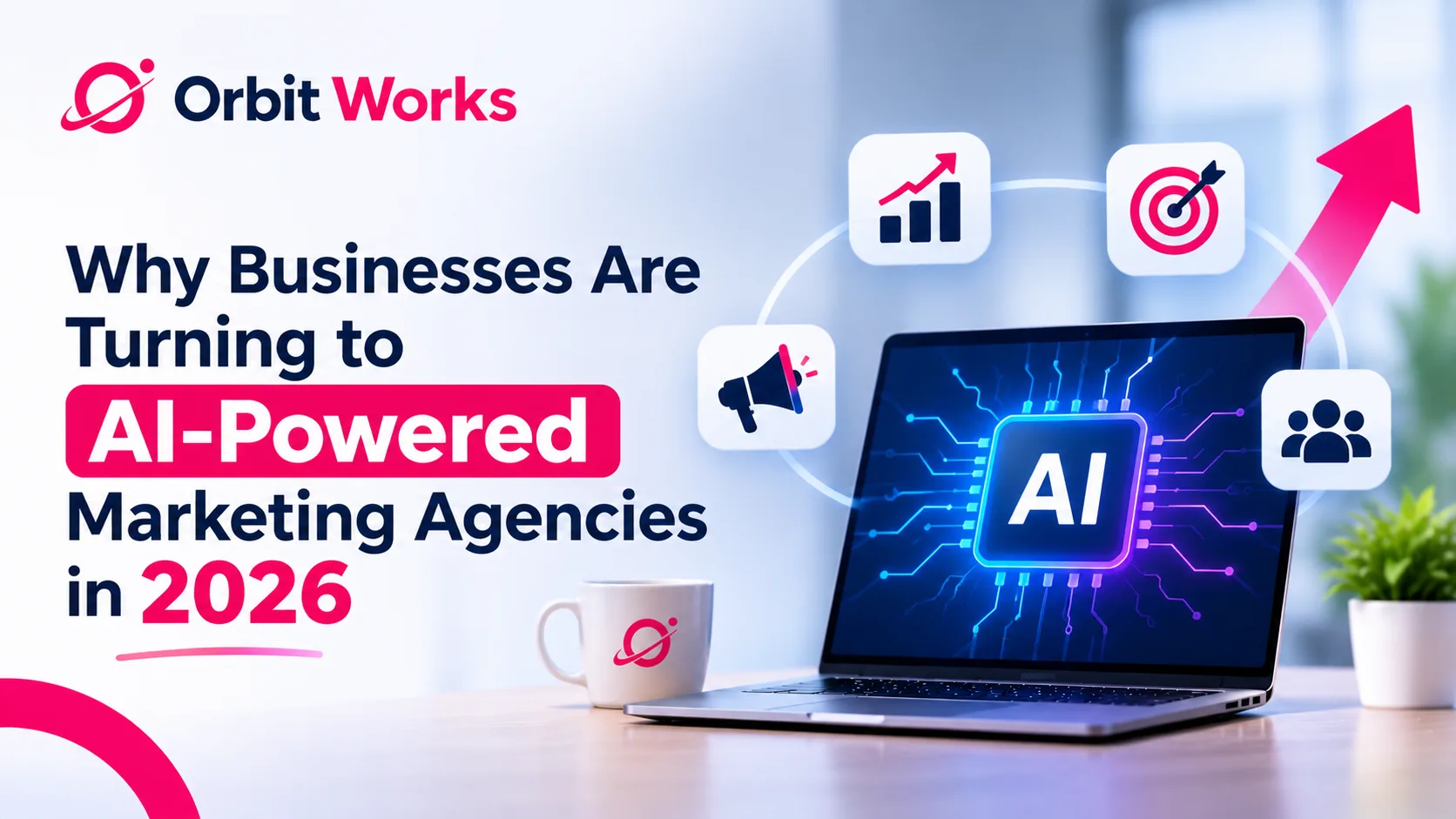
In 2026, businesses are turning to AI-powered marketing agencies because marketing has become too complex to manage manually. These agencies combine artificial intelligence with human expertise to deliver faster data analysis, smarter audience targeting, improved customer personalization, and measurable business growth.
As digital marketing channels multiply and customer expectations rise, companies that leverage AI marketing solutions gain a significant competitive advantage over those relying on traditional approaches alone. The shift toward AI-powered marketing agencies isn't just a trend, it's a strategic response to the growing demands of modern marketing.
Key Takeaways
AI-powered marketing agencies help businesses process vast amounts of customer data quickly, uncover behavioral signals, and identify purchase intent patterns that manual analysis would miss. These agencies combine marketing automation with human strategic direction to improve campaign optimization and marketing performance across all channels. Businesses choosing AI marketing agencies gain access to predictive insights, better lead quality, and stronger marketing ROI without dramatically increasing internal team size. The most successful AI-driven marketing strategies balance technology with human expertise to maintain brand positioning while achieving measurable business outcomes.
Modern Marketing
Marketing has become more complex than ever. Businesses are expected to move faster, generate more leads, personalize customer experiences, and justify every dollar spent. At the same time, competition continues to grow across nearly every digital channel, making it increasingly difficult for organizations to stand out without sophisticated marketing strategies.
That's one reason why AI-powered marketing is gaining momentum across industries. Businesses are looking for smarter ways to improve marketing performance without adding unnecessary complexity to their operations. They want solutions that work efficiently and deliver results they can measure and trust.
In this complete guide, we'll explore why more companies are partnering with AI-powered marketing agencies in 2026 and what they're hoping to achieve through that strategic shift. Whether you're a small business exploring AI marketing for the first time or an established organization looking to scale your digital marketing efforts, understanding this landscape is essential for future growth.
Business Requirement
Not long ago, businesses viewed artificial intelligence as something experimental. Something innovative. Something that early adopters could use to gain an edge over competitors. That conversation has fundamentally changed.
Today, AI is becoming part of how modern businesses operate across every department. From customer service and sales to operations and marketing, organizations are actively looking for ways to improve marketing efficiency and make better decisions through AI implementation. The question is no longer whether to adopt AI, but how to implement it effectively to drive business growth.
Marketing sits at the center of this digital transformation. Businesses are now managing more customer data than ever before, more advertising platforms competing for attention, more content channels to maintain, more competition across every market segment, and more pressure to prove marketing ROI to stakeholders. The challenge isn't a lack of opportunity, it's managing all of that complexity effectively while maintaining marketing team efficiency.
That's where AI starts to create real value for businesses of all sizes. Rather than relying entirely on manual processes, businesses can use AI-powered marketing tools to identify patterns, uncover opportunities, and support faster decision-making. The result is often better ai visibility into what is working and what needs attention, allowing marketing teams to focus their efforts where they matter most.
In competitive markets, that visibility matters enormously. The businesses that identify opportunities first often gain a lasting advantage over slower competitors.
Businesses Need More Than AI Tools to Succeed
One of the biggest misconceptions surrounding AI-powered marketing is that businesses simply need access to the right software or AI marketing tools. They don't. Most organizations already have access to more technology than they fully utilize, yet they still struggle to achieve their marketing goals.
The real challenge is turning technology into tangible results. That's where many businesses run into significant obstacles.
Companies invest in new platforms, experiment with marketing automation tools, and collect larger volumes of customer data. Yet they still struggle to answer fundamental questions about their marketing performance. Which marketing channels are driving growth? Where are leads dropping off in the customer journey? Which campaigns deserve more investment? What opportunities are being missed entirely?
AI can help answer those questions, but only when it's paired with strategic direction and human expertise. Technology alone doesn't create growth. It simply provides information and predictive insights. Businesses still need experienced marketers who can interpret that data, align insights with business goals, and build a comprehensive marketing strategy that moves the organization forward.
That's one reason more companies are turning to specialized AI marketing agencies rather than attempting to manage AI implementation internally. These agencies bring both technical capability and marketing expertise to the table, creating a combination that's difficult to replicate in-house.
How AI-Powered Marketing Agencies Improve Campaign Performance
Businesses don't hire AI-powered marketing agencies because they want more software or access to the latest AI marketing tools. They hire agencies because they want better outcomes and measurable business results.
AI marketing agencies combine advanced technology, strategic thinking, and skilled execution to help businesses improve marketing performance across multiple areas simultaneously. Let's explore the key benefits of AI-powered marketing agencies and how they deliver value.
Faster Data Analysis and Customer Data Analysis
Most businesses generate more marketing data than they can realistically analyze on their own. Website analytics, advertising metrics, customer interactions, email engagement, conversion tracking data, and sales activity all contribute to a complex picture of marketing performance.
The problem isn't access to information, it's making sense of it all. AI helps agencies process large amounts of customer data quickly and identify patterns that might otherwise take days or weeks to uncover through manual analysis. This allows businesses to move from reactive decision-making to proactive campaign optimization.
Instead of asking what happened last month, marketing teams can focus on what should happen next based on predictive insights and real-time performance data.
Smarter Audience Targeting
Audience targeting has evolved significantly over the past decade. Traditional targeting often focuses on demographics and broad customer categories. While those factors remain useful, they don't always tell the complete story about who is most likely to become a customer.
AI allows agencies to identify deeper behavioral signals that indicate purchase intent and engagement patterns. These signals include engagement patterns across channels, content interests and preferences, purchase intent indicators, customer journey trends, and historical interactions with your brand. This comprehensive approach to audience targeting creates a more accurate picture of who is most likely to convert.
The result is often better lead quality, improved campaign efficiency, and stronger returns on marketing ROI. Businesses using AI-powered marketing for audience targeting consistently outperform those relying on traditional segmentation methods alone.
Better Customer Personalization
Consumers expect relevant experiences from the brands they interact with. Generic marketing messages are becoming easier to ignore because customers encounter them constantly across every digital channel.
Businesses that deliver personalized experiences often create stronger engagement because their messaging feels more relevant to customer needs and interests. Customer personalization isn't just a nice-to-have feature, it's becoming a fundamental expectation.
AI helps agencies scale customer personalization without creating overwhelming workloads for marketing teams. Whether it's content recommendations, audience-specific messaging, or customized customer journeys, AI allows marketers to create more meaningful interactions across multiple channels simultaneously.
Personalization isn't just a marketing trend. It's an expectation that businesses must meet to remain competitive in 2026 and beyond.
More Efficient Campaign Management
Marketing teams spend significant amounts of time managing repetitive tasks that don't directly contribute to growth. Reporting, monitoring, data collection, and performance reviews are all necessary activities, but they consume valuable time that could be spent on strategic initiatives.
AI helps automate many of these operational processes through marketing automation and automated processes, allowing agencies to spend more time on marketing strategy, performance optimization, and creative execution. This shift creates substantial value for businesses.
Less time managing marketing. More time improving it. That's the promise of AI-driven marketing when implemented correctly.
AI Helps Businesses Scale Marketing Efforts Without Scaling Internal Teams
Growth creates opportunities, but it also creates pressure on existing resources. As marketing demands increase, many businesses reach a point where their internal teams become stretched thin. More campaigns, more content, more reporting, and more customer touchpoints all require additional resources that may not be available.
Traditionally, the solution was hiring more staff. Today, many businesses are taking a different approach to scaling their marketing efforts.
AI-powered marketing agencies help organizations scale their marketing efforts without significantly increasing headcount through strategic AI implementation. By combining experienced marketers with AI-driven marketing tools and automated processes, agencies can manage larger workloads more efficiently.
This allows businesses to expand their marketing capabilities while maintaining focus on their core operations. Marketing productivity increases without the overhead associated with traditional team expansion.
Marketing Decisions Are Becoming More Data-Driven
Marketing has always involved a degree of creativity and intuition. But the most successful marketing decisions are increasingly driven by data and customer data analysis.
The challenge is that most businesses have more data than they know what to do with. Website analytics. Advertising metrics. Customer behavior patterns. Conversion tracking. Sales data. The information exists in abundance, extracting meaningful insights from it is the difficult part.
AI helps agencies identify patterns, opportunities, and trends that may otherwise remain hidden in vast datasets. Instead of relying solely on assumptions or past experience, businesses can make decisions based on stronger evidence and clearer visibility into marketing performance.
This shift toward data-driven marketing is becoming increasingly important for business growth. Organizations actively adopting AI for marketing report significantly higher productivity levels and improved marketing efficiency across their operations.
Technology alone doesn't create growth. Better decisions do. Technology simply helps businesses make them faster and with greater confidence.
The Human Element Still Matters in AI-Powered Marketing
Despite all the excitement surrounding artificial intelligence and AI-powered innovation, businesses still need people. Experienced, strategic, creative people who understand how to build brands and connect with customers.
AI can process information at incredible speed. It can analyze vast datasets, identify patterns, and generate predictive insights. What AI cannot do is understand a company's unique vision, build genuine relationships with customers, or replace strategic thinking that comes from years of experience.
The strongest marketing outcomes happen when technology and human expertise work together in harmony.
AI helps marketers analyze information faster, identify opportunities sooner, automate repetitive processes, and improve overall marketing efficiency. Human marketers provide strategic direction, creative thinking, brand positioning, business context, and deep customer understanding.
One without the other creates limitations. Together, they create momentum that drives business growth.
What Businesses Should Look for in an AI-Powered Marketing Agency
Not all agencies approach AI the same way. Some use it as a marketing buzzword to attract clients without delivering real value. Others use it as a practical tool to improve outcomes and drive measurable business results.
When evaluating AI-powered marketing agencies, businesses should look for several key qualities. A clear strategic process that demonstrates how AI will be integrated into marketing efforts. Proven marketing expertise and a track record of successful campaigns. Transparency around technology usage and data handling practices. Strong data analysis capabilities and the ability to translate insights into action. A focus on measurable business outcomes rather than vanity metrics.
Most importantly, businesses should look for an agency that understands their specific goals and can tailor AI marketing solutions to meet those needs. Technology matters, but results matter more.
How AI Helps Businesses Improve Audience Targeting and Lead Quality
Understanding your audience is fundamental to marketing success. AI takes audience targeting to a new level by analyzing behavioral signals and purchase intent indicators that traditional methods simply cannot capture at scale.
When businesses use AI in digital marketing, they gain access to deeper insights about their customers. How do different segments behave at various stages of the customer journey? What content resonates most with specific audience groups? When are customers most likely to make purchase decisions?
These predictive insights help agencies develop more effective marketing strategies that improve lead quality and marketing ROI. AI-driven marketing doesn't just reach more people, it reaches the right people with the right message at the right time.
How AI Improves Marketing Campaign Performance and ROI
Marketing campaign management becomes significantly more effective with AI-powered insights. Campaign optimization happens continuously as AI analyzes performance data and identifies opportunities for improvement.
Businesses using AI-powered marketing agencies see improvements in advertising metrics, conversion tracking accuracy, and overall marketing ROI. The technology enables real-time adjustments that maximize campaign effectiveness while minimizing wasted spend.
AI marketing solutions help businesses understand which channels are performing best, which creative approaches resonate with audiences, and where opportunities for improvement exist. This continuous optimization creates a compounding effect that drives increasingly better results over time.
Conclusion
Businesses aren't turning to AI-powered marketing agencies simply because AI is popular or trendy. They're doing it because marketing has become more complex, competition has intensified, and expectations continue to rise across every industry.
AI helps businesses work smarter by processing data faster, identifying opportunities sooner, and automating repetitive processes. Experienced marketers help businesses move in the right direction by providing strategic direction, creative thinking, and genuine customer understanding.
The organizations achieving the strongest results in 2026 are combining both AI-powered marketing technology and human expertise. They're not replacing one with the other, they're creating a powerful combination that drives sustainable business growth.
As AI implementation continues to evolve, businesses that embrace AI marketing strategies for businesses will be better positioned to compete, scale, and thrive in an increasingly complex digital landscape.
Contact us today to start the conversation about how AI marketing services can transform your business.
FAQs
1. What are AI-powered marketing agencies?
AI-powered marketing agencies are specialist partners that combine artificial intelligence tools with human marketing expertise. They use data analysis, automation, predictive insights, and campaign optimization to improve audience targeting, personalization, and marketing ROI. Rather than replacing strategy, these agencies use AI to process complex customer data faster, then apply experienced judgement to build measurable digital marketing strategies for business growth.
2. Why are businesses turning to AI-powered marketing agencies in 2026?
Businesses are turning to AI-powered marketing agencies in 2026 because digital marketing has become more complex, competitive, and data-heavy. Agencies combine AI marketing tools with strategic expertise to improve campaign performance, personalize customer experiences, automate repetitive processes, and prove marketing ROI. This helps businesses scale marketing efforts, improve lead quality, and make faster, evidence-based decisions without dramatically expanding internal teams.
3. How does AI improve marketing campaign performance?
AI improves marketing campaign performance by analyzing website analytics, advertising metrics, conversion tracking, and customer behavior in real time. It identifies patterns, predicts purchase intent, and highlights which channels or messages drive results. Agencies then use those predictive insights for continuous campaign optimization, better audience targeting, and smarter budget allocation. This often improves lead quality, marketing efficiency, and measurable marketing ROI.
4. How do AI marketing agencies improve audience targeting?
AI marketing agencies improve audience targeting by analyzing behavioral signals, engagement patterns, content interests, purchase intent, and customer journey trends. This creates a more accurate picture of who is likely to convert. Agencies can then build audience segments, tailor messaging, and allocate budget toward higher-value prospects. The result is better lead quality, improved campaign efficiency, and stronger returns on digital marketing investment.
5. How does AI improve customer personalization?
AI improves customer personalization by using customer data analysis and behavioral signals to tailor content, recommendations, offers, and journeys at scale. Instead of generic messages, businesses can deliver audience-specific experiences across channels without overwhelming marketing teams. This typically increases engagement, strengthens customer relationships, and supports conversion tracking. Personalization becomes an automated, measurable process while human marketers guide brand positioning, creative direction, and strategic priorities.
6. How should businesses choose an AI-powered marketing agency?
Choose an AI-powered marketing agency by checking strategic process, proven marketing expertise, transparency around AI tools, strong data analysis, and focus on measurable business outcomes. Ask how they use AI marketing solutions, protect customer data, and integrate human expertise. Review case studies, reporting clarity, and whether they understand your goals. The best agency combines AI-driven marketing efficiency with strategic direction and brand understanding.
7. Will AI take over marketing agencies?
AI will not fully take over marketing agencies, but it will reshape them. Agencies that ignore AI may struggle with speed, data complexity, and personalization. Successful agencies will use AI for analysis, automation, and predictive insights while relying on human expertise for strategy, creativity, relationships, and brand positioning. The future is human-led, AI-assisted marketing. Clients still buy judgement, accountability, and creative direction.
8. What is the 30% rule in AI?
The 30% rule in AI is not a formal standard, but in marketing it often means starting by automating or augmenting roughly 30% of repetitive tasks, or allocating about 30% of testing effort to AI experiments. It encourages controlled AI implementation, measurable pilots, and human oversight before scaling. Treat it as a planning heuristic, not a universal law. Results should guide expansion.
9. What is the 3-3-3 rule in marketing?
The 3-3-3 rule in marketing is not universally defined. It commonly refers to a planning heuristic such as three audience segments, three core messages, and three priority channels, or three seconds to capture attention, three touches to build familiarity, and three interactions to encourage conversion. Use it as a simple framework for focus, consistency, and campaign structure, not a rigid rule.
10. Why are companies promoting AI?
Companies promote AI because it can improve marketing efficiency, automate repetitive processes, speed up customer data analysis, and support data-driven decisions. AI also enables personalization, audience targeting, and campaign optimization at scale, which can improve lead quality and marketing ROI. Promotion also builds trust, attracts talent, and positions brands as innovative, but results depend on strategy and human expertise. Hype alone is not strategy.