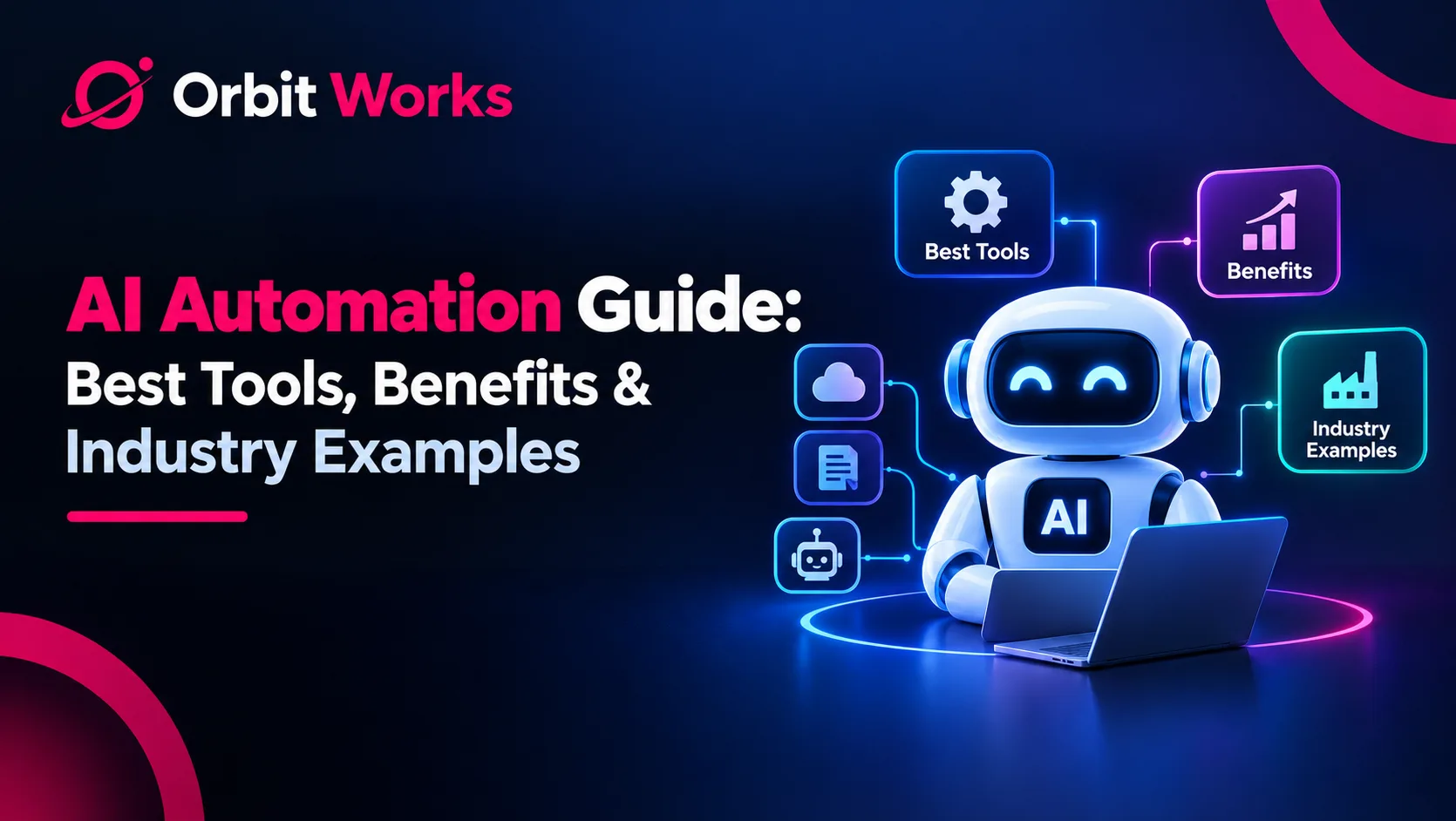
AI Automation Guide: Best Tools, Benefits & Industry Examples
AI automation is transforming how businesses operate. This guide covers what it is, the best tools, proven benefits, and real industry examples to help you get started.
What Is AI Automation?
AI automation is the use of artificial intelligence to handle and optimize tasks that previously depended on human judgment. Unlike traditional automation, which relies on rigid rules, AI automation adapts, learns, and tackles data-rich or unpredictable scenarios. It combines machine learning, natural language processing, and predictive analytics to create intelligent workflows that improve over time.
If you want the short version: AI automation is not just about speed. It is about enabling smarter workflows so your team can focus on growth instead of chasing bottlenecks. Businesses everywhere are making AI-driven automation a core strategy for staying competitive and resilient.
Understanding what is digital marketing helps put this into context. AI automation is not just a technology trend. It is a fundamental shift in how work gets done. And when you understand How Do Search Engines Actually Work, you realize that AI is reshaping discovery, decision-making, and customer engagement across every channel.
Why AI Automation Matters Right Now
If you look around, you will see that work is fundamentally changing. Businesses everywhere face mounting pressure to deliver faster, better, and with less overhead. Having watched technology reshape workflows firsthand, I can tell you that AI automation is now the quiet engine behind true digital transformation, and it is here to stay.
So what does this actually mean for your team? AI-powered automation is not just a trendy buzzword. It is a smarter approach to solving business problems that once seemed too complex to automate. Today, organizations of every size are making AI-driven automation a core strategy for staying competitive and resilient.
Modern organizations face more data and complexity than ever. AI automation lets you handle high-variation tasks, not just basic ones. It helps you make smarter, faster decisions using live data. And it allows you to adapt quickly as business needs or markets shift.
Traditional Automation vs AI Automation: What Is the Difference?
Let me be direct about this distinction because it matters. Traditional automation, like macros or scripted workflows, works great for clear, repetitive processes. But add an exception, a new data type, or an unexpected scenario, and these systems stumble.
AI-powered automation changes the game. With tools like machine learning and natural language processing, AI can analyze unstructured data, recognize patterns, and improve from experience. This means less rigidity, more real-time adaptability, and the ability to automate complex tasks that were once impossible for machines alone.
Traditional RPA follows strict rules. It cannot handle exceptions. It works for fixed data entry, moving files, and basic screen scraping. Onboarding costs are high because it requires IT developers to script and maintain exact paths. And it usually operates in silos or requires complex API bridging.
AI automation understands intent, processes natural language, and adapts to unstructured data. It works for invoice processing, customer query resolution, and sentiment analysis. Onboarding costs are medium to low because it often features no-code interfaces and natural language prompting. And it is built directly into workspaces for immediate, team-wide access.
Understanding Search intent in SEO helps here. The same principle applies to automation. You need to understand what the user or system is trying to accomplish before you design the solution.
The Three-Stage Implementation Logic for AI Automation
Many organizations struggle to deploy AI because they view it purely as a tech stack upgrade rather than a business process transformation. Throwing AI at a broken process just gets you faster errors. To get real return on investment, I always guide teams through a proven three-stage implementation logic: Discover, Decide, and Act.
Discover is the data ingestion stage. The system first identifies and extracts relevant information from your workspace. Instead of manual data entry, AI tools read documents, emails, and chat logs to understand the context of a request.
Decide is the cognitive processing stage. Next, the AI evaluates the extracted data against your business rules and historical patterns. If a client asks for a refund, the system analyzes the policy, checks the purchase history, and determines the valid outcome without human bottlenecks.
Act is the workflow execution stage. Finally, the platform executes the required steps. This could mean updating a database, sending an approval request to a manager, or directly messaging the customer with the resolution.
This three-stage logic is what separates successful AI automation implementation from failed experiments. When you understand What Are SEO KPIs, you can apply the same measurement discipline to your automation initiatives.
Key Benefits of AI Automation
AI automation wipes out repetitive manual work like data entry, reconciliation, and chasing down approvals. This not only cuts costs but dramatically reduces mistakes, letting your team double down on creative, high-impact work.
With the massive data businesses generate, finding timely insights is tough. AI automation solves this by turning raw information into instant action. It can cluster feedback, forecast demand, or rank support tickets so you can respond to customers or issues with unmatched speed and clarity.
As your business evolves, manual workflows quickly become roadblocks. AI automation scales easily, tackling more tasks and complexity without increasing costs. Intelligent workflows can pivot quickly as new priorities or challenges arise, so you are always ready for what is next.
By handling tedious work, automation frees your team for meaningful projects, boosting morale and retention. On the customer side, response times shrink, personalization improves, and delays disappear. The result is seamless experiences for customers and more rewarding work for employees.
Building a topic cluster around your automation use cases helps you document and share what works across your organization. Staying current with keyword research trends ensures your content strategy aligns with what your audience actually needs.
AI Automation Use Cases by Industry
The possibilities of AI automation are vast and growing, but some industries stand out as pioneers and beneficiaries. Let me walk you through the most high-value use cases I have seen making a real difference.
AI Automation in Finance
Financial institutions handle huge volumes of sensitive data and are subject to tight regulations. AI automation now powers everything from automated document verification and transaction monitoring to detecting potential fraud and streamlining regulatory reporting. It does not just save time. It adds a layer of security and reliability that manual processes cannot match.
A practical example is loan processing. Instead of pouring over hundreds of loan applications, an AI automation system can flag outliers, check documentation accuracy, and accelerate approval workflows. This gives staff more time to handle complex cases and strengthen client relationships. Many institutions choose to develop custom web development solutions that handle automation tailored to their specific operational and compliance needs.
AI Automation in Healthcare
In healthcare, the ability to access and analyze data quickly can be literally life-saving. Hospitals use AI automation to digitize and update medical records, schedule appointments, and manage billing. In diagnostics, AI can sift through test results and flag anomalies, assisting clinicians in real time. For patients, this means shorter wait times and fewer administrative errors, which are core ingredients for better health outcomes.
AI Automation in Customer Service
Companies worldwide are using AI-powered chatbots, intelligent ticketing, and sentiment analysis to deliver fast, context-aware support. Some organizations are also deploying an AI receptionist to automatically greet callers, route inquiries, and handle basic customer requests without human intervention. A customer question submitted via email, social media, or live chat is routed, prioritized, and even answered automatically when possible. As a result, businesses can handle higher volumes of inquiries, resolve issues round-the-clock, and maintain a consistently positive customer experience.
AI Automation in Sales and Marketing
Sales and marketing teams are awash with data. AI automation transforms cold leads into warm prospects, scores those prospects for readiness, and delivers personalized messaging across channels. Automated campaign management means the right message goes to the right customer at the right time, freeing up sales teams to focus on closing deals. AI telemarketing is another emerging use case that scales outreach without sacrificing personalization.
Staying current with keyword research trends and identifying High-Volume, Low-Competition Keywords becomes easier with AI-powered tools. Best AI SEO Tools leverage AI in digital marketing to make content optimization more efficient.
AI Automation in IT and Operations
AI automation is increasingly critical in IT, where it manages everyday issues like password resets, monitors systems for performance or security anomalies, and supports rapid response to incidents. Operations departments use automated workflows to manage everything from procurement approvals to inventory checks, delivering reliability and freeing technical staff for higher-level projects.
AI Automation in HR and Content Creation
Many are surprised to learn that areas like content creation and HR are also seeing big gains. AI automation helps draft or curate content, analyze engagement, and streamline recruitment by automatically ranking candidates or scheduling interviews. When the time-consuming administrative work is handled, creative and people teams can turn their attention to what they do best: storytelling and building culture.
Content optimization and content optimization tools become more powerful when combined with AI automation. Keyword Cannibalization becomes easier to avoid when AI analyzes your content at scale.
Best AI Automation Tools for Business Teams
Choosing the right tools is critical to unlocking the full value of AI automation. The market is rich with options, from all-in-one collaborative suites to deeply specialized process engines. Let me walk you through the leading platforms and what makes each one stand out.
Make.com offers a visual scenario builder with a drag-and-drop interface for designing multi-step, multi-app automations across thousands of supported services. It provides powerful conditional logic for complex routing, filtering, and branching within workflows. Rich integrations include pre-built modules for cloud apps, webhooks, databases, and API endpoints. Transparent run histories make it easy to monitor, debug, and optimize every scenario in real time. This tool is best for technical users and teams that need to connect diverse tools with full visual transparency into how data flows.
Zapier
Zapier is famous for quick setup and ease of use. Its minimalist trigger-action logic makes it ideal for solo users or small teams. It has a large app ecosystem with hundreds of business and productivity apps that can be connected without code. AI-powered suggestions recommend optimized workflows based on your needs and historical data. AI triggers and enrichment allow you to use AI for email parsing, content classification, or routing tasks. This tool is best for small and mid-sized operations wanting to automate cross-app tasks without complexity.
UiPath
UiPath is an enterprise-grade RPA suite that automates repetitive work in legacy desktop and web apps through robotic agents. Its AI skills and add-ons include document recognition, NLP, and advanced decisioning modules to extend classic RPA into truly smart automation. Rich orchestration and governance features include enterprise dashboards, advanced error handling, and compliance tools. It is customizable and scalable, handling everything from a single department bot to enterprise-wide process automation. This tool is best for larger organizations with significant legacy systems or compliance needs.
Blue Prism
Blue Prism focuses on stability and security. It is trusted by highly regulated industries for robust controls and detailed audit trails. It offers customizable process automation for building advanced, rule-guided automations with high flexibility. Integration with cognitive services supports plugging in AI models for language, vision, and decision support. This tool is best for regulated sectors like finance and healthcare who need automation at scale with maximum traceability.
Moveworks
Moveworks provides conversational AI for IT and HR. It uses AI chatbots to understand and solve employee requests instantly, from password resets to answering HR policy questions. Seamless platform integration plugs into Teams, Slack, or other workspaces for native employee experiences. Analytics and self-improving support continuously learn from ticket data to resolve more issues automatically over time. This tool is best for internal support and operations teams aiming to reduce support workloads and speed up employee help.
AI Automation and Collaboration Platforms
Some platforms combine collaboration and automation seamlessly for business teams. They offer a comprehensive suite that combines chat, video meetings, cloud docs, calendars, and task tracking with automation in the same interface. Smart data management automation uses AI-driven tagging, extraction, categorization, and summarization to organize content according to custom rules. Tailored AI workflows let users create personalized AI prompts within the platform to precisely fit unique business needs. Automated meeting minutes generation transcribes and summarizes meetings automatically. Pre-designed AI automation templates offer ready-made solutions for common business scenarios. Deep integrations and open API enable connections with third-party business applications. Smart approval routing reads the context of requests and instantly routes them to the correct approver. OKR auto-archiving connects daily task management directly to your OKR dashboard. These platforms are best for businesses or teams seeking a unified, easy-to-manage workspace that accelerates automation and collaboration, especially where non-technical users need to drive process improvements quickly.
AI automation companies in the USA like OrbitWorks can help you evaluate these tools and build a strategy that fits your specific needs. When you are considering Staff Augmentation vs Managed Services or evaluating Traditional Hiring vs. Staff Augmentation, look for partners who understand AI automation.
How to Choose the Right AI Automation Platform
Start with your users and pain points. Where are the bottlenecks? Who will build and maintain flows? Prioritize no-code for business users. The faster a non-technical person can create value, the quicker automation ROI. Test integrations and scalability. Ensure the platform can grow with your business and connect tools you already rely on. Pilot your top tool. Always run a small-scale workflow or process as a trial and gather team feedback before rolling out at scale.
For businesses working with digital marketing services in USA or an AI automation company USA partner, these considerations ensure that your investment delivers measurable results. IT Staff Augmentation Demand has grown as companies recognize the value of specialized skills.
AI Automation Implementation Roadmap
I have seen the best AI automation campaigns start small and then expand as wins accumulate. Here is a simple but powerful roadmap for integrating AI automation in your organization.
First, work with stakeholders to identify repetitive, time-consuming tasks. Document current workflows, pain points, and opportunities for improvement. Rank tasks by frequency, manual effort required, and expected business impact. Start with quick win processes your team is already comfortable with because momentum matters.
Next, translate one of your mapped workflows into an automated process using your chosen platform. Run this as a pilot, measure outcomes, and refine as you go. Automation works best when everyone feels involved. Offer clear, upbeat training and communicate how automation will improve, not replace, their work.
Once your initial automations are running smoothly, expand into more complex workflows. Monitor not just technical performance but user satisfaction and business results. Tweak and optimize regularly.
Do not automate everything at once. Start with a few processes, build knowledge, and gradually expand. Beware of data silos. Ensure new automated processes integrate fully with business-critical systems. Keep security top of mind. Regularly review access controls and data handling workflows to maintain compliance.
Adopting AI automation is a continuous process of learning and improvement, but every small win builds confidence and delivers measurable results. Understanding What Are SEO KPIs helps you apply the same measurement discipline to your automation initiatives.
Challenges and Risks of AI Automation
Handing over business-critical operations to AI raises immediate concerns about data privacy and uncontrolled errors. A rogue automated task can leak sensitive internal data or execute incorrect external communications, severely damaging your brand reputation and compliance standing.
You must prioritize platforms that enforce human-in-the-loop (HITL) checkpoints. I advise setting up clear permission models, detailed audit logs, and manual approval gates for any automated action affecting clients or finances. Always ensure the provider complies with strict enterprise security standards before granting them access to your core business data.
Teams often get stuck trying to automate complex, cross-departmental processes from day one. When you aim too high initially, integration hurdles and edge cases stall the deployment, frustrating everyone involved and delaying your return on investment. I always recommend starting with high-volume, low-complexity tasks. Focus on routine data entry, IT helpdesk ticket routing, and standard HR onboarding queries. Using a unified platform, you can instantly automate approval routing and basic team requests to get quick wins before tackling advanced, multi-system data syncing.
Choosing between low-code and no-code platforms can be tricky when you want to empower business users without alienating developers. If you go strictly no-code, your engineering team might hit a wall when building custom backend logic. If you lean too heavily into low-code, marketing and HR will still rely on IT for every minor workflow tweak. The best approach I have found is a hybrid model. Look for tools that offer intuitive drag-and-drop interfaces for everyday users alongside API access for developers.
Free AEO and GEO Audit Tool options can help you evaluate whether your content and technical setup support AI automation initiatives. Understanding How Do Search Engines Actually Work ensures your automation investments support your broader digital strategy.
The Future of AI Automation
Looking ahead, I see AI automation evolving on several exciting fronts.
The move is not just toward automating single tasks but creating seamless, interconnected webs of automated processes, what analysts now call hyperautomation. This leverages multiple AI and RPA technologies together for truly end-to-end process optimization.
AI automation will become even more democratized, with platforms making advanced workflows available to all business users, not just IT teams. Expect more visual, drag-and-drop builders, natural language workflow creation, and integrated AI assistants.
AI is getting better at handling ambiguity and nuance. Future workflows will automatically adapt to changing business rules, market conditions, and customer feedback, using predictive analytics and continual learning.
AI automation will continue to bridge gaps within organizations, connecting customer support, HR, finance, IT, and beyond, enabling faster, more coordinated action.
As repetitive tasks recede, people will focus more on creative, interpersonal, and strategy-driven work. AI automation will not replace humans but will reallocate their time to more meaningful, value-adding endeavors.
AI in digital marketing will continue to transform how campaigns are planned, executed, and measured. Best AI SEO Tools will become more sophisticated, and content optimization will become more automated. Off page SEO and on page strategy both benefit from AI-powered insights.
Frequently Asked Questions About AI Automation
What is AI automation?
AI automation is the use of artificial intelligence to handle and optimize tasks that previously depended on human judgment. Unlike traditional automation, which relies on rigid rules, AI automation adapts, learns, and tackles data-rich or unpredictable scenarios. It combines machine learning, natural language processing, and predictive analytics to create intelligent workflows.
What is the difference between traditional automation and AI automation?
Traditional automation follows set rules. It works for repetitive, predictable tasks but struggles with exceptions. AI automation can learn from data, adapt to changes, and make decisions in complex situations. Traditional RPA is best for fixed data entry. AI automation is best for invoice processing, customer query resolution, and sentiment analysis.
What are the benefits of AI automation?
AI automation speeds up processes, reduces manual errors, and allows employees to focus on higher-value, creative work. It cuts costs, improves decision-making, enhances customer experience, and scales easily as your business grows. It also boosts employee morale by removing tedious tasks.
Which industries benefit most from AI automation?
Finance, healthcare, customer service, IT, marketing, and HR all benefit from increased efficiency and smarter decision-making. AI automation is transforming document verification, fraud detection, medical records management, customer support, lead scoring, and recruitment.
How do I implement AI automation in my business?
Start with high-volume, low-complexity tasks. Focus on routine data entry, IT helpdesk ticket routing, and standard HR onboarding queries. Use a unified platform to instantly automate approval routing and basic team requests. Get quick wins before tackling advanced, multi-system data syncing.
Is AI automation expensive for small businesses?
No. Many platforms offer scalable, no-code and low-code solutions that do not require large upfront investments, making AI automation accessible to smaller teams. Start with a focused use case, prove the ROI, and expand from there.
Does AI automation replace human jobs?
No. AI automation takes over routine and repetitive tasks but works best when complementing humans, freeing them for complex, strategic activities. The businesses that succeed with AI automation are those that invest in retraining and help their workforce adapt to new roles.
What are the risks of AI automation?
Risks include data breaches, improper access, and compliance issues. Use trusted tools, implement proper access controls, and monitor workflows regularly. Prioritize platforms that enforce human-in-the-loop (HITL) checkpoints. Set up clear permission models, detailed audit logs, and manual approval gates for any automated action affecting clients or finances.
How do I measure AI automation ROI?
Track time saved, error reduction, process speed, and employee satisfaction before and after implementation. Regularly review these metrics to ensure continued value. Understanding What Are SEO KPIs helps you apply the same measurement discipline to your automation initiatives.
What is the future of AI automation?
The future is hyperautomation, democratized access, and more autonomous systems. AI automation will become more integrated into every layer of business operations. Agentic AI and autonomous AI agents will handle complex, multi-step tasks across platforms. Low-code and no-code AI automation will democratize access. The AI automation companies that embrace this future will define the next decade of business operations.
Conclusion:
As we look at the future of work, it is clear that AI automation is not just a passing wave. It is the foundation for building more agile, efficient, and resilient organizations. The benefits are practical and immediate: faster workflows, smarter decision-making, improved accuracy, and more meaningful work for your team.
Whether you are just beginning your automation journey or looking to scale existing efforts, now is the perfect time to embrace this technology and prepare your business for what is next. AI automation companies in the USA like OrbitWorks can help you assess your needs, identify the right use cases, and implement solutions that deliver measurable results.
When you understand what is digital marketing in the age of AI, you realize that AI automation is not optional. It is a competitive necessity. IT Staff Augmentation Demand has grown as companies recognize the value of specialized skills. When evaluating Staff Augmentation vs Managed Services or considering Traditional Hiring vs. Staff Augmentation, look for partners who understand AI automation.
Best AI SEO Tools can help you measure and improve your visibility. Digital marketing services in USA providers can help you build a strategy. And AI automation company USA providers are building the tools that make AI automation accessible to businesses of all sizes.
The future belongs to businesses that embrace automation. The question is not whether you will adopt AI automation. It is whether you will do it before your competitors do.
Your Next Step
Ready to explore how AI automation can transform your business? Contact our team today for a free consultation. We will assess your workflow, identify automation opportunities, and provide a realistic roadmap. No pressure. Just honest advice from experienced professionals.
Get Your Free AI Automation Assessment – Let's build a smarter, more efficient business together
Explore Our Services – Discover how we can help you achieve digital transformation success