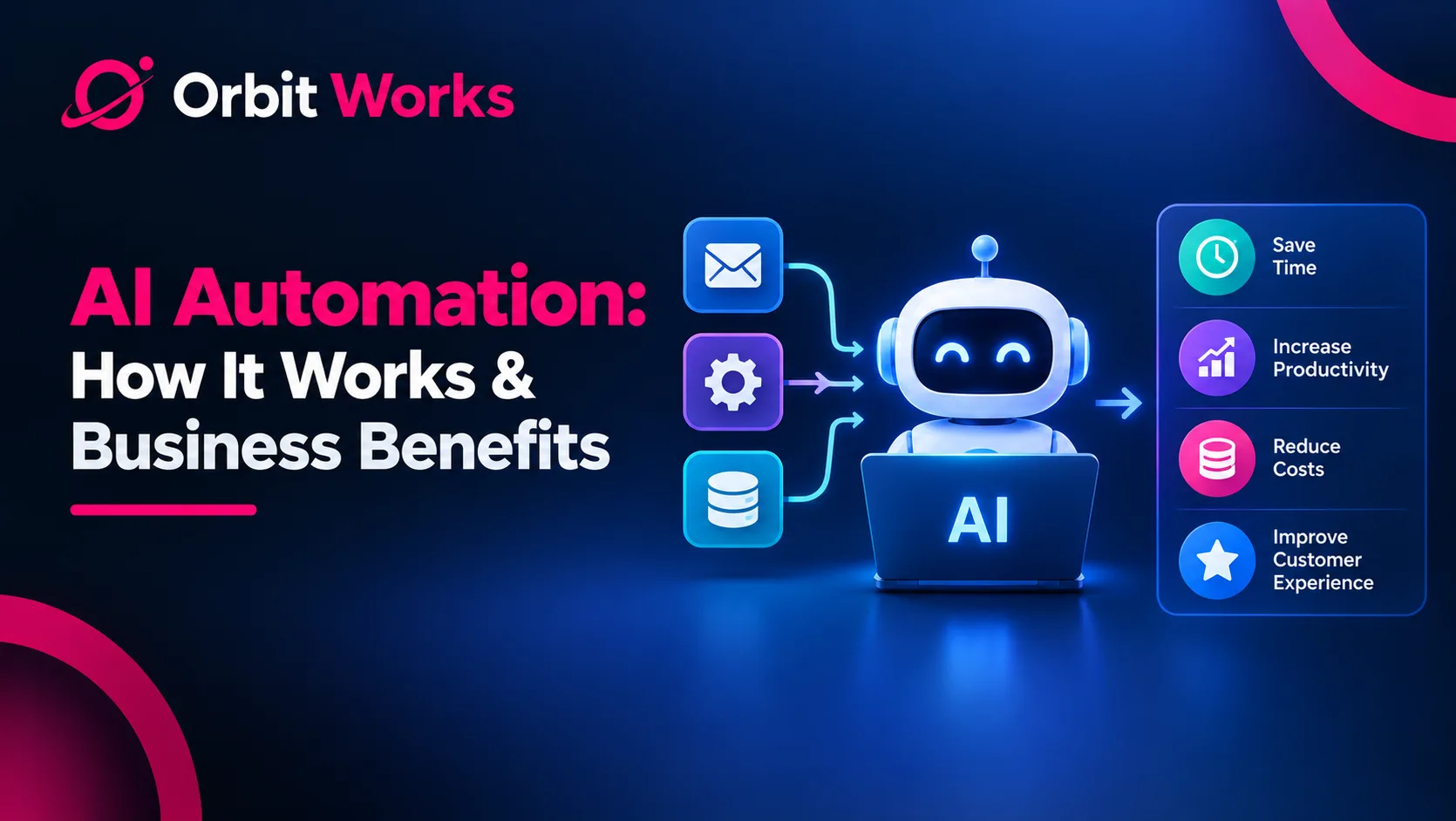
AI Automation: How It Works & Business Benefits
AI automation uses artificial intelligence to handle complex business tasks with minimal human intervention. Discover how it works, its benefits, and real-world use cases.
What Is AI Automation in Business?
AI automation in business is the use of artificial intelligence, including machine learning, natural language processing, and predictive analytics, to handle business tasks with minimal human intervention. Unlike traditional automation that follows fixed rules, AI automation adapts over time, learns from data, and can make decisions on complex, unstructured workflows.
As you read this sentence, AI agents are already at work, streamlining operations, answering customer inquiries, and analyzing vast amounts of data. With a market set to reach $1.3 trillion by 2030, AI automation is driving the decline of banal and repetitive tasks, transforming operations, and unlocking opportunities.
Understanding what is digital marketing helps put this into context. AI automation is not just a technology upgrade. It is a fundamental shift in how businesses operate. When you understand How Do Search Engines Actually Work, you realize that AI is reshaping every aspect of how we work and compete.
Key Takeaways: AI Automation at a Glance
Hybrid Automation Intelligence (HAI) combines traditional Digital Process Automation (DPA) with Generative AI and Machine Learning to create smarter, more adaptive systems.
Operational Efficiency and ROI are significant. AI-driven automation reduces administrative overhead, with the potential to cut labor costs by up to 30 percent and reduce process build times by 75 percent.
Proactive Governance and Risk Management is a major advantage. Instead of reactive auditing, systems use AI Ambient Agents to provide 24/7 real-time monitoring. This ensures proactive compliance with regulatory standards like GDPR or ISO by detecting anomalies and validating data at the point of capture.
How Does AI Automation Work?
AI automation leverages machine learning and advanced algorithms to analyze data and make decisions that drive task automation. Let me walk you through the process.
The process starts with data ingestion. AI gathers and analyzes both structured and unstructured data from various sources. Machine learning models then uncover insights, detect anomalies, and predict future trends. Based on this intelligence, automation tools execute tasks, reducing the need for manual oversight.
For instance, consider how Downer simplified their most complex process, the Permit to Dig. A previously manual, paper-based task mandating multiple approvals has been transformed into a streamlined digital workflow. By integrating digital forms with GIS data, AI automation helped Downer push real-time information to field teams via handheld devices. Teams now receive the right information at the right time, allowing them to make faster, safer decisions and significantly reduce the risk of service strikes.
When you build a topic cluster around your automation use cases, you document and share what works across your organization. Staying current with keyword research trends ensures your content strategy aligns with what your audience actually needs.
AI vs Automation: What Is the Difference?
This distinction matters, so let me be direct about it. Automation relies on fixed instructions to handle repetitive, structured tasks like data entry or invoice processing. It follows strict rules but lacks flexibility and adaptability.
AI, on the other hand, brings intelligence into the process. It analyzes large datasets, identifies patterns, and evolves over time. These systems can handle ambiguity, learn from experience, and make independent decisions.
Consider a customer service chatbot. A basic bot follows a script, while an AI-powered bot understands intent, learns from each interaction, and continuously improves its responses. The difference is stark. One is static. The other adapts and refines itself.
In short, automation boosts speed and efficiency, while AI infuses adaptability and intelligence, making processes smarter and more dynamic. AI automation in business combines both to deliver the best of both worlds.
Benefits of AI Automation in Business Processes
Let me walk you through the five key benefits of AI automation that I have seen make the biggest impact.
1. Improve Productivity and Reduce Costs
From data entry to customer inquiries, AI takes care of routine work, freeing up teams to focus on strategic initiatives. According to McKinsey, AI automation can slash labor costs by 30 percent for several industries. This allows operating more efficiently with smaller teams while maintaining high levels of accuracy and output.
Understanding What Are SEO KPIs helps you measure the impact of AI automation on your operations. Track time saved, error reduction, and process speed.
2. Detect Anomalies and Risks Proactively
AI-driven monitoring systems enhance risk management by identifying anomalies in real time for a proactive response. Advanced technologies now provide comprehensive visibility, enabling companies to anticipate disruptions and streamline operations.
3. Enable End-to-End Supply Chain Visibility
Only 60 percent of suppliers have comprehensive visibility of their tier-one suppliers. This can lead to inefficiencies and compliance risks. AI-powered tools provide real-time insights by mapping complex supplier networks, identifying vulnerabilities, and ensuring regulatory compliance.
For example, Semantic Visions uses its AI-driven mapping tool to analyze vast amounts of global data in real time. This helps quickly spot vulnerable supplier relationships and identify compliance risks and ESG violations.
4. Improve Cross-Departmental Collaboration
AI process automation streamlines workflows, reduces manual tasks, and enhances team collaboration by providing real-time insights and facilitating seamless communication. For instance, the Liverpool School of Tropical Medicine implemented a no-code process automation platform to replace paper-based processes, resulting in improved cross-departmental collaboration and operational efficiency. Staff proactively sought ways to enhance their practices, leading to a more collaborative environment.
5. Accelerate Process Automation with AI Assistants
With the rise of AI, process automation now offers 24/7 assistance, providing answers to process-related questions, guiding automation, analyzing data, and ensuring workflows run smoothly. This makes the entire experience faster and more efficient.
AI automation companies in the USA like OrbitWorks are helping businesses implement these benefits without the complexity of enterprise systems. When you are considering Staff Augmentation vs Managed Services or evaluating Traditional Hiring vs. Staff Augmentation, look for partners who understand AI automation.
Challenges of AI Automation
Although AI automation is beneficial for streamlining operations, it introduces several challenges that businesses must address.
1. AI Bias and Decision Transparency
AI models learn from historical data, which can embed biases and lead to unfair outcomes. In hiring, for example, an AI-powered recruitment tool trained on past trends may unintentionally favor certain demographics, limiting diversity.
The bigger issue is that many AI models function as black boxes, where decisions are made without clear explanations. Without transparency, businesses cannot identify or correct biases. Ensuring fairness requires explainable AI, regular audits, and diverse training datasets.
2. Security Vulnerabilities in Automated Workflows
AI automation introduces new security risks, as automated systems handle sensitive data, making them prime targets for cyberattacks. Hackers can exploit AI weaknesses, manipulate decision-making models, or inject harmful data.
For instance, an AI fraud detection system could be compromised by misleading data, allowing fraudulent transactions to go undetected. AI-powered customer service bots can also be tricked into revealing confidential information. Businesses must prioritize continuous AI monitoring, strict access controls, and regular security updates to mitigate these threats.
3. Bad Data to Feed AI Models
The data you provide to AI models directly impacts their outputs. Using incorrect or corrupted data can cause major problems with your AI platform down the line. This is why process automation serves as an ideal foundation for your AI journey. With process automation, you can gather, standardize, and securely store your data in the cloud. AI models built on clean data will be better equipped to scale your AI initiatives.
Understanding Content optimization and content optimization tools helps you maintain clean data across your digital presence. Keyword Cannibalization becomes easier to avoid when AI analyzes your content at scale.
7 AI Automation Use Cases Across Industries
Let me take you through seven compelling AI automation use cases across various sectors.
1. Vendor Risk Assessment in Insurance
Financial services firms managing hundreds of third-party vendors face complex regulatory requirements, needing consistent risk assessments for security, compliance, and data privacy. Traditionally, these assessments involved manual questionnaires, document reviews, and subjective scoring, resulting in slow, error-prone processes with limited auditability.
AI automation streamlines this by automating the collection and analysis of vendor information. AI-powered agents review questionnaires, penetration test reports, and certification documents, scoring risk consistently, flagging anomalies, and triggering follow-up workflows automatically. This automation accelerates vendor risk reviews, reduces human error, and ensures consistent governance across all vendors. Decisions are transparent, auditable, and easily scalable.
2. Manufacturing
Predictive maintenance is transforming manufacturing by using AI to anticipate equipment failures before they happen. This allows companies to address issues early, minimizing downtime and improving efficiency. For example, BMW Group's Regensburg plant uses AI and automation to analyze data from conveyor systems, detecting anomalies like power fluctuations.
AI also optimizes inventory by analyzing historical sales data and market trends, helping manufacturers maintain ideal stock levels and avoid overproduction or shortages. Additionally, it automates site inspections and compliance audits, ensuring strict regulatory adherence while reducing manual oversight.
3. HR Onboarding
AI accelerates onboarding processes by automating repetitive tasks like document verification, resume parsing, assigning IT access, tracking compliance, contract signing, and much more. With AI-powered process automation, HR teams can focus on engaging new hires instead of chasing paperwork, ensuring productivity and integration of new hires.
4. Healthcare
AI is significantly improving patient care and diagnostics by helping healthcare providers detect diseases earlier and more accurately. AI-driven tools are used to analyze medical images like CT scans and X-rays, detecting conditions such as cancer and other abnormalities with high precision. Additionally, AI models have been deployed in intensive care units to predict patient deterioration, enabling faster, more proactive care.
Beyond detection and diagnostics, AI automation allows hospital staff and clinicians to focus on patient care by automating lengthy paperwork and tedious workflows. For instance, Blackpool Teaching Hospitals gained a time-saving approach, improving accuracy and reducing the administrative and clinical burden.
5. Energy
Dresser Natural Gas Solutions, a leading provider of measurement and piping solutions, standardized and accelerated compliance tracking and document management using AI automation. By automating critical administrative processes, companies like NGS can focus on optimizing energy delivery and ensuring grid reliability.
6. Banking and Financial Services
Integrating AI-driven automation has significantly enhanced operational efficiency in the banking sector. These systems assist financial institutions in automating transaction monitoring, risk assessment, and incident reporting, thereby aiding compliance with regulations such as the Digital Operational Resilience Act.
Moreover, AI plays a critical role in detecting and preventing fraud by analyzing transaction patterns in real time. Machine learning algorithms can identify anomalies and flag suspicious activities, helping banks detect fraudulent behavior more quickly and accurately.
7. Insurance
AI is revolutionizing the insurance industry by automating key processes like claims processing, fraud detection, and underwriting. For example, Aon leveraged AI automation to automate critical tasks such as GDPR requests and regulatory audits, improving transparency, efficiency, and ensuring compliance.
With AI assistants, processes such as insurance claims can be built in minutes compared with traditional process building.
Custom web development projects can integrate these automation capabilities directly into your digital products. The same applies to mobile app development and Flutter for app development. Building automation into your digital products enhances the customer experience and operational efficiency.
The Future of Work and AI Automation
The World Economic Forum's Future of Jobs Report 2025 predicts a net increase of 78 million new jobs by 2030, as businesses balance automation with workforce transformation. Automation and AI are redefining the workplace, driving efficiency, and reshaping job roles.
Automation of Routine Tasks
AI is taking over repetitive tasks such as data entry, scheduling, and compliance tracking. This allows employees to focus on high-value work that requires creativity, critical thinking, and emotional intelligence. As routine processes become automated, organizations can reduce operational costs while improving accuracy and efficiency.
Shifting Job Roles and Skill Demands
As AI automates repetitive functions, job roles will shift. The growing demand for AI and automation literacy means employees must reskill and focus on developing strategic, creative, and tech-centric capabilities.
Human-AI Collaboration
The future is not about replacing humans but creating a seamless partnership between human expertise and AI intelligence. For instance, if AI-powered tools handle routine customer service queries, human agents can use their free time to address complex issues that require empathy and critical thinking.
IT Staff Augmentation Demand has grown as companies recognize the value of specialized skills. IT Staff Augmentation in USA providers can connect you with AI and automation specialists who understand your business. When evaluating Staff Augmentation vs Managed Services or considering Traditional Hiring vs. Staff Augmentation, look for partners who understand AI automation in business.
How AI Automation Connects to Your Broader Digital Strategy
AI automation does not exist in isolation. It connects to every aspect of your digital presence.
When you are planning custom web development projects, AI automation can be integrated from the start. The structure of your website affects how easily AI systems can find and cite your content. The same applies to mobile app development and Flutter for app development.
When evaluating Custom Website vs Template Website or Website builders vs custom development, consider how each option supports AI automation. Custom solutions typically offer more flexibility for integrating AI capabilities.
Content optimization and content optimization tools become more powerful when combined with AI automation. Best AI SEO Tools leverage AI in digital marketing to make keyword research and content optimization more efficient.
Off page seo and on page strategy both benefit from AI-powered insights. Internal linking strategy becomes easier to implement when AI analyzes your content structure.
Search intent in SEO is fundamental to AI automation in business. When you understand what users want, you can automate the processes that deliver it.
Digital marketing services in usa providers are increasingly offering AI automation as part of their service offerings. If you need expert help, consider working with a team that understands both traditional marketing and AI automation.
AI automation company usa providers like OrbitWorks are building tools that make AI automation in business accessible and affordable. Their expertise in custom web development, mobile app development, and IT staff augmentation makes them a valuable partner for businesses serious about digital transformation.
Frequently Asked Questions About AI Automation
What is the difference between traditional automation and AI automation?
Traditional automation follows fixed rules and handles repetitive, structured tasks. AI automation uses machine learning and natural language processing to adapt, learn, and make decisions on complex, unstructured workflows. AI brings intelligence into the process.
How do AI agents improve business compliance?
AI agents provide 24/7 real-time monitoring and proactive compliance with regulatory standards. They detect anomalies and validate data at the point of capture, ensuring that issues are identified and addressed immediately rather than through reactive auditing.
Can non-technical users build AI-driven workflows?
Yes. Many AI automation platforms offer no-code interfaces that allow non-technical users to build and manage workflows. This democratizes access to automation and enables business users to drive process improvements without relying on IT.
What are the benefits of AI automation in business processes?
AI automation improves productivity and reduces costs, detects anomalies and risks proactively, enables end-to-end supply chain visibility, improves cross-departmental collaboration, and accelerates process automation with AI assistants.
What are the challenges of AI automation?
Challenges include AI bias and decision transparency, security vulnerabilities in automated workflows, and the need for clean data to feed AI models. Addressing these challenges requires explainable AI, regular audits, diverse training datasets, and robust security measures.
What industries benefit most from AI automation?
Finance, healthcare, manufacturing, insurance, banking, energy, and HR all benefit from AI automation. The specific use cases vary, but the benefits of efficiency, accuracy, and scalability apply universally.
How does AI automation improve supply chain management?
AI automation provides real-time insights by mapping complex supplier networks, identifying vulnerabilities, and ensuring regulatory compliance. It helps companies anticipate disruptions and streamline operations.
What is the future of work with AI automation?
The future is human-AI collaboration. AI takes over repetitive tasks, allowing employees to focus on creative, strategic, and interpersonal work. Job roles will shift, and employees will need to reskill for AI and automation literacy.
Conclusion:
AI automation in business is not just a passing wave. It is the foundation for building more agile, efficient, and resilient organizations. The benefits are practical and immediate: faster workflows, smarter decision-making, improved accuracy, and more meaningful work for your team.
Whether you are just beginning your automation journey or looking to scale existing efforts, now is the perfect time to embrace this technology and prepare your business for what is next. AI automation companies in the USA like OrbitWorks can help you assess your needs, identify the right use cases, and implement solutions that deliver measurable results.
Best AI SEO Tools can help you measure and improve your visibility. Digital marketing services in USA providers can help you build a strategy. And AI automation company usa providers are building the tools that make AI automation in business accessible to organizations of all sizes.
The future belongs to businesses that embrace automation. The question is not whether you will adopt AI automation. It is whether you will do it before your competitors do.
Your Next Step
Ready to explore how AI automation can transform your business? Contact our team today for a free consultation. We will assess your workflow, identify automation opportunities, and provide a realistic roadmap. No pressure. Just honest advice from experienced professionals.
Get Your Free AI Automation Assessment – Let's build a smarter, more efficient business together
Explore Our Services – Discover how we can help you achieve digital transformation success