Staff Augmentation vs Managed Services: Which Is Best?
Staff augmentation vs managed services is a critical decision for business leaders. Compare control, cost, scalability, and risk to find the right fit for your digital transformation journey.
The way most companies build their technical teams is broken. They either hire too many permanent employees, creating fixed costs that strain their budgets. Or they outsource everything, losing control over quality and intellectual property. Neither approach works well.
I have watched companies waste millions on outsourcing projects that delivered poor quality and missed deadlines. I have seen teams struggle with staff augmentation because they did not have the internal leadership to manage external talent effectively. And I have watched smart leaders find the sweet spot by understanding exactly when to use each model.
The choice between Staff Augmentation vs Managed Services is not just about cost. It is about control, quality, scalability, and risk. Choose the wrong model, and you will waste money, frustrate your team, and fall behind competitors. Choose the right one, and you will accelerate delivery, reduce costs, and build a resilient workforce.
So let me break down these two models so you can make the right decision for your business.
Understanding what is digital marketing helps you see that your technology decisions directly impact your marketing effectiveness. The Staff Augmentation vs Managed Services choice affects your ability to execute campaigns, launch products, and serve customers.
What Is Staff Augmentation vs Managed Services?
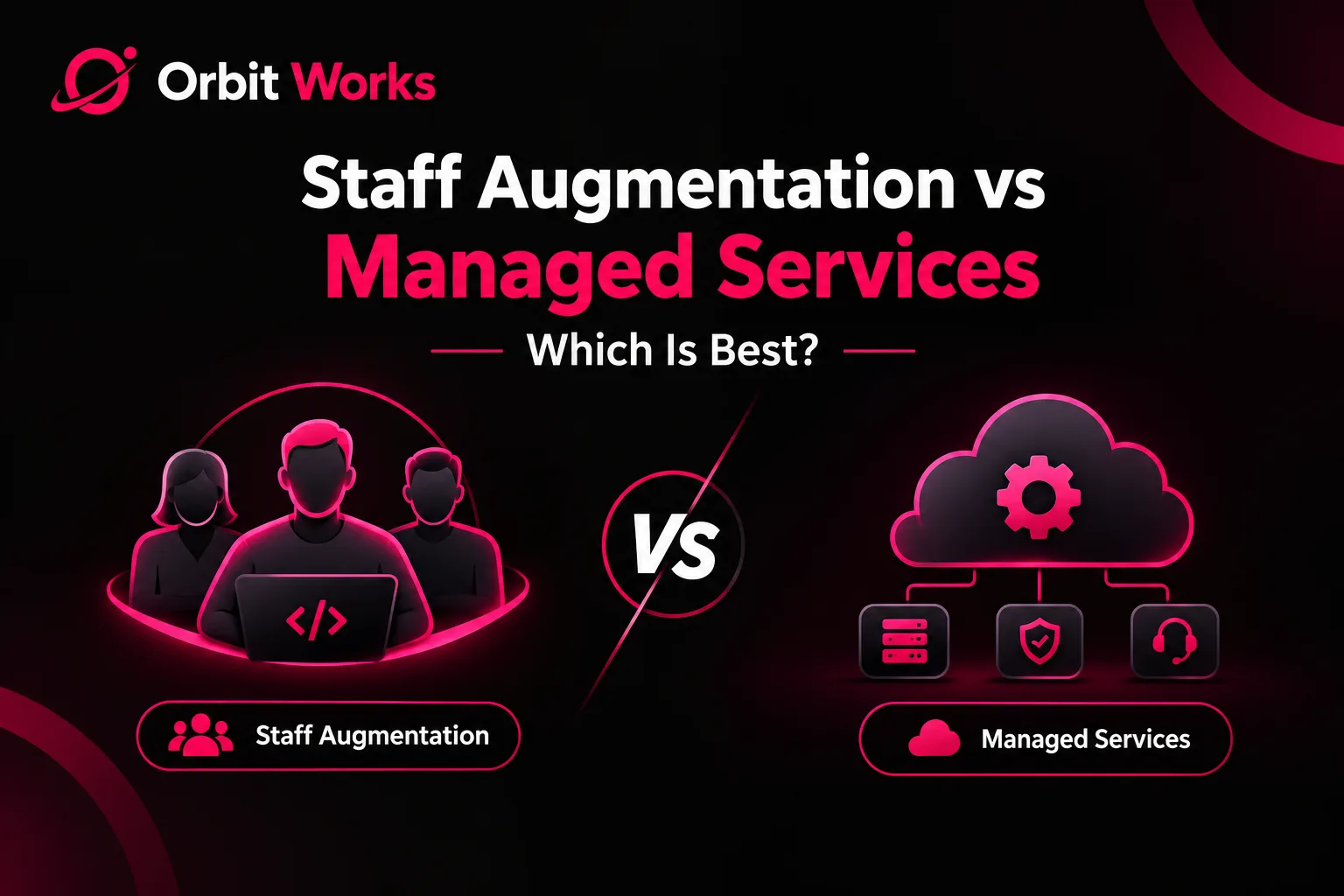
Before we dive deeper, let me answer this question directly. Staff augmentation adds external talent to your existing team while you retain full control over management and direction. Managed services outsource an entire function to a provider who takes full responsibility for delivery.
The key difference is control. Staff augmentation puts you in the driver's seat. You make the decisions, manage the work, and own the outcomes. Managed services put the provider in the driver's seat. They make the decisions, manage the work, and own the outcomes.
Understanding this distinction is the first step to choosing the right model for your business. Each model serves different needs, and the right choice depends on your internal capabilities, your risk tolerance, and your business goals.
IT Staff Augmentation Demand has surged in 2026 as companies recognize the value of flexible workforce models. Meanwhile, the managed services market continues to grow as companies seek predictable costs and reduced management overhead. The Staff Augmentation vs Managed Services decision requires careful analysis of your internal capabilities and business goals.
What Is Staff Augmentation?
Let me define staff augmentation clearly.
Staff augmentation is a workforce strategy where you bring external professionals into your existing team for a specific period or project. These skilled professionals work alongside your permanent employees. They report to your managers. They follow your processes. They use your tools. But you do not hire them permanently.
The key characteristic of staff augmentation is integration. Augmented staff becomes part of your team. They attend your standups, contribute to your codebase, and participate in your culture. They are your employees in every way except the paperwork.
Key Features of Staff Augmentation
You retain full control over management and direction
Augmented staff integrates into your existing team
You pay only for the duration of the engagement
You can scale up and down as needs change
You own all intellectual property
When Is Staff Augmentation Used?
Staff augmentation is typically used for project-based work, specialized skills, variable demand, and capacity gaps. It is ideal when you have a clear scope of work and the internal leadership to manage external talent.
For businesses needing expertise in custom web development or mobile app development, staff augmentation provides access to specialized skills without permanent commitments. Similarly, if you're exploring Flutter for app development, staff augmentation gives you access to Flutter experts exactly when you need them.
What Are Managed Services?
Now, let me define managed services.
Managed services is a model where you outsource an entire function or project to an external provider. That provider takes full responsibility for delivery. They assign their own project managers, their own skilled professionals, and their own processes. You specify the outcomes you want, and they deliver them.
The key characteristic of managed services is delegation. You hand over responsibility. The provider manages the work, the team, and the results. You focus on the business outcomes, not the day-to-day execution.
Key Features of Managed Services
The provider has full control over execution
You specify outcomes, not how to achieve them
You pay a fixed fee or subscription
The provider handles all management and administration
The provider may retain some intellectual property
When Are Managed Services Used?
Managed services are typically used for ongoing operations, non-core functions, and projects where you lack internal expertise. They are ideal when you do not have the leadership capacity to manage external talent yourself.
Staff Augmentation vs Managed Services: The Core Differences
Let me highlight the key differences between Staff Augmentation vs Managed Services.
Control – With staff augmentation, you retain full control. You manage the work, assign tasks, and make technical decisions. You are in the driver's seat. With managed services, you delegate control. The provider manages the work, assigns tasks, and makes technical decisions. You are in the passenger seat.
Integration – With staff augmentation, external talent integrates into your team. They become part of your culture and processes. With managed services, the provider's team operates independently. They may not integrate with your culture or processes.
Management – With staff augmentation, you manage the work. You need internal leadership capacity to direct and supervise augmented staff. With managed services, the provider manages the work. You do not need internal leadership for the outsourced function.
Intellectual Property – With staff augmentation, you own everything. The code, the design, the intellectual property all belong to you. With managed services, IP ownership can be complex. Some providers retain rights to their work. You need to negotiate IP terms carefully.
Cost Structure – With staff augmentation, you pay for the time your augmented staff works. Costs are variable and tied to usage. With managed services, you pay a fixed fee or subscription. Costs are predictable but may include a premium for the provider's management overhead.
Risk – With staff augmentation, you bear execution risk. You are responsible for delivery. With managed services, the provider bears execution risk. They are responsible for delivery.
When to Choose Staff Augmentation
Let me tell you when staff augmentation is the right choice.
You Have Strong Internal Leadership – Staff augmentation works best when you have strong internal leaders who can manage external talent. You need project managers, tech leads, and engineering leaders who can direct and integrate augmented staff.
You Have a Clear Scope of Work – Staff augmentation is ideal when you have a clear scope of work. You know what needs to be done, and you just need extra hands to do it.
You Want to Maintain Control – If you want to retain full control over technical decisions, quality standards, and intellectual property, staff augmentation is the right choice.
You Need Specialized Skills – If you need specialized skills that you do not have on your permanent team, staff augmentation lets you access those skills on demand.
You Have Variable Demand – If your workload fluctuates, staff augmentation gives you the flexibility to scale up and down as needed.
You Want Integration – If you want external talent to integrate with your team and become part of your culture, staff augmentation is the better model.
The rise of AI in digital marketing has created demand for specialized skills that staff augmentation can fill quickly. Companies need professionals who understand AI tools, data analytics, and marketing automation without the overhead of permanent hiring.
When to Choose Managed Services
Now let me tell you when managed services are the right choice.
You Lack Internal Leadership – If you do not have the internal leadership to manage external talent, managed services is the better choice. The provider handles all management.
You Want to Delegate Non-Core Functions – If the work is not core to your business, delegate it. Let a managed services provider handle non-core functions so you can focus on what matters.
You Want Predictable Costs – If you want predictable, fixed costs, managed services offer subscription-based pricing. You know exactly what you will pay each month.
You Lack Internal Expertise – If you do not have the internal expertise to execute a project, managed services let you access a provider's expertise. They bring the talent and the knowledge.
You Want to Reduce Management Overhead – If you want to reduce the management overhead of building and leading a team, managed services is the answer. The provider handles everything.
You Have Ongoing Operational Needs – If you have ongoing operational needs that require consistent support, managed services provide the continuity you need.
Staff Augmentation vs Managed Services: A Detailed Comparison
Let me give you a detailed comparison of Staff Augmentation vs Managed Services across key dimensions.
Control and Governance – Staff augmentation gives you full control. You make the decisions. You own the outcomes. You are responsible for quality. Managed services give the provider control. They make the decisions. They own the outcomes. They are responsible for quality.
Integration and Culture – Staff augmentation integrates external talent into your team. They become part of your culture and processes. Managed services keep the provider's team separate. They may not integrate with your culture.
Management Responsibility – Staff augmentation requires you to manage the work. You need project managers and tech leads to direct the augmented staff. Managed services put management responsibility on the provider. You do not need to manage the work.
Cost Structure – Staff augmentation has variable costs. You pay for the time your augmented staff work. Managed services have fixed costs. You pay a predictable subscription or fee.
Scalability – Staff augmentation is highly scalable. You can add or remove resources within days. Managed services are scalable but may require contract adjustments. Adding capacity may take longer.
Intellectual Property – Staff augmentation gives you full IP ownership. Everything belongs to you. Managed services may have IP complexities. Negotiate IP terms carefully.
Risk Allocation – Staff augmentation puts execution risk on you. You are responsible for delivery. Managed services put execution risk on the provider. They are responsible for delivery.
The Traditional Hiring vs. Staff Augmentation comparison shows similar advantages for flexibility and cost control. When evaluating Staff Augmentation vs Managed Services, consider how each aligns with your internal capabilities.
Cost Comparison: Which Model Is More Cost-Effective?
Let me give you a realistic cost comparison.
Staff Augmentation Cost
With staff augmentation, you pay:
Hourly or monthly rate for each augmented professional
No recruitment fees
No benefits
No equipment costs
No management overhead (you provide management)
Total cost: $90,000 to $135,000 for a 9-month engagement with a senior engineer at typical market rates
Managed Services Cost
With managed services, you pay:
Fixed monthly fee or project-based fee
Includes the provider's management overhead
Includes the provider's profit margin
May include the provider's IP or tools
Total cost: 20% to 50% higher than staff augmentation due to the provider's management and profit margin
Which Is More Cost-Effective?
For most project-based work, staff augmentation is more cost-effective because you are not paying for the provider's management overhead. You pay only for the talent.
For ongoing operations where you lack internal management capacity, managed services may be more cost-effective. The provider's management overhead is worth paying to avoid hiring your own managers.
The IT Staff Augmentation in USA market offers competitive rates that make staff augmentation an attractive option for cost-conscious companies.
Risk and Control: Who Holds the Power?
Let me compare risk and control between the two models.
Control
Staff augmentation gives you maximum control. You control the work, the team, the quality, and the intellectual property. You are in the driver's seat.
Managed services give you less control. The provider controls the work, the team, the quality, and may control the IP. You are in the passenger seat.
Execution Risk
Staff augmentation puts execution risk on you. If the project fails, you are responsible. You bear the cost and the reputational damage.
Managed services put execution risk on the provider. If the project fails, they are responsible. They bear the cost and the reputational damage.
Quality Risk
Staff augmentation gives you control over quality. You set the standards, review the work, and ensure quality.
Managed services give the provider control over quality. You rely on their standards and processes.
Financial Risk
Staff augmentation has lower financial risk because costs are variable and tied to usage. If demand drops, you reduce costs.
Managed services have a higher financial risk because costs are fixed. If demand drops, you are still paying.
The Verdict
Staff augmentation offers higher control and lower financial risk but higher execution risk. Managed services offer lower control and higher financial risk but lower execution risk. Choose based on your risk tolerance and management capacity.
Understanding How Do Search Engines Actually Work helps you appreciate why technical control matters. When you retain control through staff augmentation, you can ensure SEO best practices are followed throughout development.
Scalability and Flexibility: Which Model Adapts Better?
Let me compare scalability and flexibility.
Staff Augmentation Scalability
Staff augmentation is highly scalable. You can add resources within days. You can reduce resources within days. You match your workforce to your workload with precision.
Managed Services Scalability
Managed services are less scalable. Adding capacity may require contract amendments and may take weeks. Reducing capacity may have minimum contract terms.
The Flexibility Verdict
Staff augmentation wins on scalability and flexibility. It is designed for variable demand and rapid adaptation. Managed services are designed for stability and predictability.
When you're building a topic cluster content strategy, the flexibility of staff augmentation allows you to bring in content specialists and SEO experts as needed. You can scale your content team for major projects and reduce headcount when the work is done.
How Staff Augmentation and Managed Services Support Your Digital Strategy
Both models play important roles in digital transformation. Understanding when to use each is key to success.
Content Optimization and SEO
Content optimization and content optimization tools are areas where both models can add value. With staff augmentation, you bring in specialists who understand your content goals and integrate with your team. With managed services, you outsource content creation and optimization to a provider who delivers results.
Off page seo and on page strategy both require specialized knowledge. Augmented SEO professionals can implement technical improvements that boost your search rankings. They understand the nuances of link building, content structure, and user engagement.
Effective internal linking strategy becomes easier to implement when you have experts who understand how to connect your content for maximum SEO benefit. Whether through staff augmentation or managed services, having SEO expertise is essential.
Technology Decisions
When making decisions about Custom Website vs Template Website or Website builders vs custom development, having expertise from augmented staff can be invaluable. They bring experience from multiple projects and can provide objective assessments.
IT Staff Augmentation Demand is rising precisely because companies need this flexibility. The Staff Augmentation vs Managed Services decision often comes down to whether you need specialized expertise integrated into your team or a complete solution delivered by a provider.
How to Make the Right Decision for Your Business
Making the right choice between Staff Augmentation vs Managed Services requires an honest assessment. Here is a framework to help you decide.
Step 1: Assess Your Internal Leadership – Do you have project managers and tech leads who can direct external talent? If yes, staff augmentation is viable. If not, consider managed services.
Step 2: Define Your Needs – Do you need project-based work or ongoing operations? For project-based work, staff augmentation is often better. For ongoing operations, managed services may be better.
Step 3: Evaluate Your Budget – Do you prefer variable costs or fixed costs? For variable costs, choose staff augmentation. For fixed costs, choose managed services.
Step 4: Consider Your Risk Tolerance – Are you comfortable bearing execution risk? If yes, staff augmentation gives you more control. If not, managed services transfers risk to the provider.
Step 5: Think About Scalability – Do you need to scale quickly and frequently? If yes, staff augmentation is more flexible. If not, managed services may suffice.
Step 6: Consider IP Ownership – Is IP ownership critical? If yes, staff augmentation gives you full ownership. If not, managed services may be acceptable.
Staying current with keyword research trends helps you identify the skills and expertise your business needs. Whether you choose staff augmentation or managed services, understanding market trends guides your decisions.
Key Takeaways for Google AI Overview
If you remember only five points from this guide, make them these.
Staff Augmentation vs Managed Services is a choice between control and delegation. Staff augmentation gives you control over the work, team, and quality. Managed services delegates control to the provider.
When to choose staff augmentation – You have strong internal project managers and tech leads, your work is project-based, you need specialized skills on demand, IP ownership is critical, and you need flexibility to scale up and down quickly.
When to choose managed services – You lack internal management capacity, you need predictable fixed costs, the work is non-core to your business, you want to transfer execution risk to a provider, and you have ongoing operational needs.
Cost comparison – Staff augmentation is typically 20% to 50% less expensive than managed services for project-based work because you are not paying for the provider's management overhead.
The smartest workforce strategy is hybrid – Use both models where they fit best. Match the model to your specific needs, capabilities, and risk tolerance.
These five points will guide you toward the right workforce strategy for your business.
Frequently Asked Questions
What is the difference between staff augmentation and managed services?
Staff augmentation adds external talent to your existing team while you retain control. Managed services outsource an entire function to a provider who takes full responsibility. Staff augmentation gives you control. Managed services give you delegation. This is the core of Staff Augmentation vs Managed Services.
Which is more cost-effective, staff augmentation or managed services?
For project-based work, staff augmentation is more cost-effective because you pay only for talent. Managed services include the provider's management overhead and profit margin. For ongoing operations where you lack management capacity, managed services may be worth the premium.
When should I choose staff augmentation?
Choose staff augmentation when you have strong internal leadership, a clear scope of work, need specialized skills, want to maintain control, and need flexibility to scale up and down. This is particularly valuable for custom web development and mobile app development projects.
When should I choose managed services?
Choose managed services when you lack internal leadership, want to delegate non-core functions, prefer predictable costs, lack internal expertise, or have ongoing operational needs.
How does intellectual property differ between the models?
With staff augmentation, you own everything. With managed services, IP ownership can be complex. Some providers retain rights to their work. Negotiate IP terms carefully.
Which model has higher execution risk?
Staff augmentation puts execution risk on you. You are responsible for delivery. Managed services put execution risk on the provider. They are responsible for delivery.
Which model is more scalable?
Staff augmentation is more scalable. You can add or remove resources within days. Managed services may require contract amendments and take weeks.
Can I use both models together?
Yes, many companies use a hybrid approach. Staff augmentation for project-based work and specialized skills. Managed services for ongoing operations and non-core functions.
How do I choose the right model?
Assess your internal leadership, define your needs, evaluate your budget, consider your risk tolerance, think about scalability, and consider IP ownership. This framework will guide your decision.
What is the future of workforce strategy?
The future is hybrid. Companies will use a mix of permanent employees, staff augmentation, and managed services. The key is matching the model to the need. IT Staff Augmentation in USA is growing as companies embrace flexible workforce models.
How does staff augmentation help with digital marketing?
AI in digital marketing requires specialized skills that staff augmentation can provide. You can bring in AI specialists, data analysts, and marketing automation experts without permanent commitments.
What about content optimization?
Content optimization using content optimization tools can be handled through either model. Staff augmentation gives you experts who integrate with your team. Managed services give you a complete content solution.
Conclusion
Let me bring this all together. The choice between Staff Augmentation vs Managed Services is one of the most important decisions you will make for your business.
Staff augmentation gives you control, flexibility, and cost efficiency. It is ideal when you have strong internal leadership and need to access skilled professionals on demand. You own the IP. You manage the work. You scale as needed. This is why IT Staff Augmentation Demand continues to surge.
Managed services give you delegation, predictable costs, and reduced management overhead. It is ideal when you lack internal leadership and want to outsource non-core functions. The provider handles everything.
Neither model is universally better. The right choice depends on your specific needs, capabilities, and risk tolerance. The smartest approach is to understand both models and use them where they fit best.
The Traditional Hiring vs. Staff Augmentation comparison has already shown the advantages of flexible workforce models. The Staff Augmentation vs Managed Services comparison adds another dimension to your decision-making.
If you are still unsure, start small. Try a staff augmentation engagement for a specific project. See how it works. If you need more support and less management, consider managed services for other functions. Build your own hybrid model that works for your business.
The global workforce is becoming more dynamic and unpredictable. Companies that rely solely on permanent headcount are struggling to adapt. Those that embrace flexible workforce strategies are thriving. Understanding the difference between staff augmentation and managed services is not just an academic exercise. It is a competitive imperative.
As you evaluate these models, remember that neither is inherently better. The right choice depends on your business context. Your internal leadership capabilities. Your budget. Your risk tolerance. Your growth plans.
Your Next Step
Ready to build the right workforce strategy for your business? Contact our team today for a free consultation. We will assess your needs, compare the models, and recommend the right approach for your specific situation. No pressure. Just honest advice from experienced professionals.
Get Your Free Workforce Strategy Assessment – Let's find the right fit for your business
Explore Our Services – Discover how we can help you build a resilient workforce