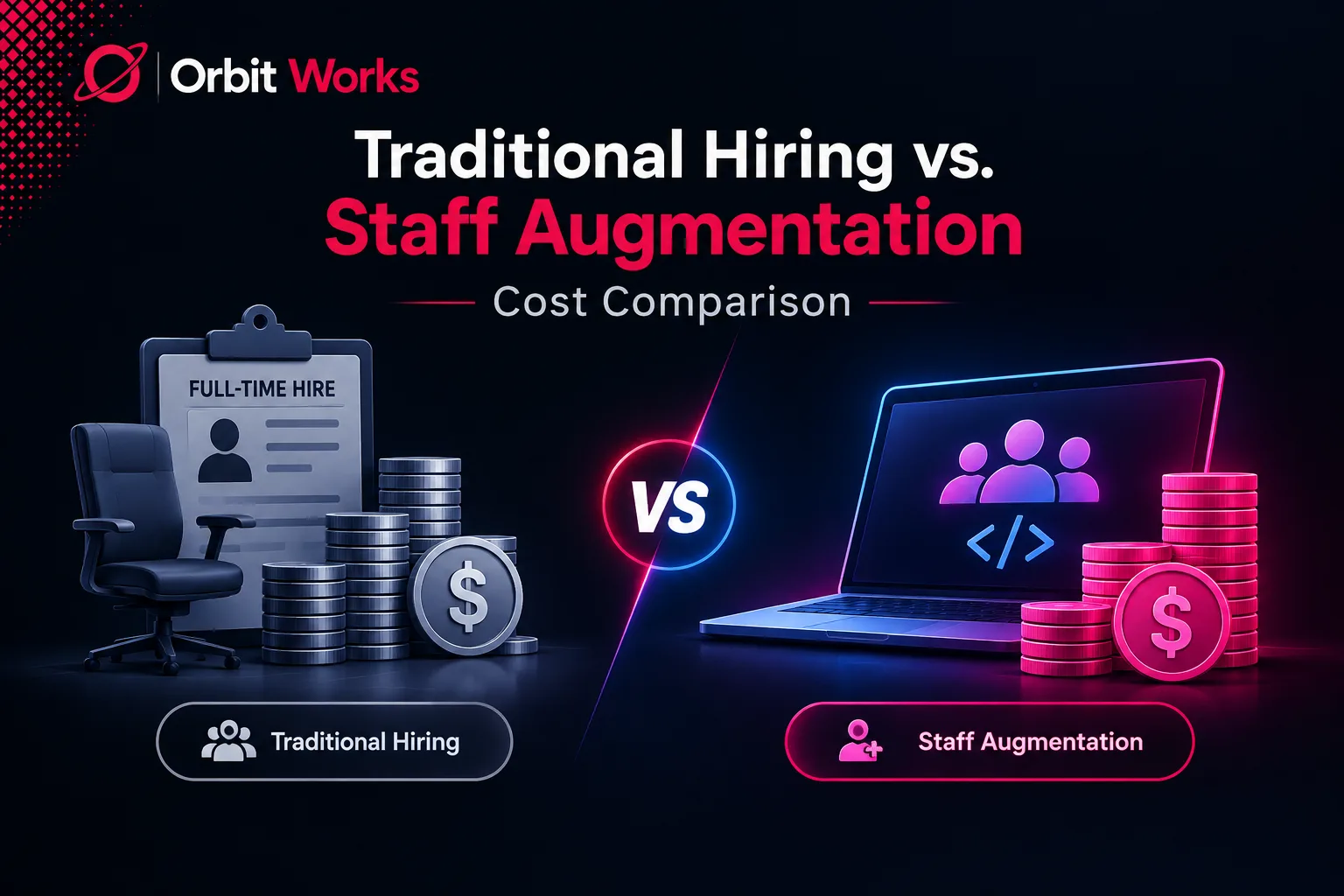
Traditional Hiring vs. Staff Augmentation: Cost Comparison
The cost of traditional hiring vs. staff augmentation is a critical business decision. Compare recruitment fees, salaries, onboarding, and flexibility. Discover why IT staff augmentation saves money.
The way most companies hire software engineers is financially irrational. You spend tens of thousands on recruitment fees. You wait months for candidates to join. You pay salaries and benefits for people who may not work out. And when your product road map slips because you are understaffed, you lose revenue that you will never recover.
I have watched companies spend $50,000 recruiting a single engineer, only to have them leave within a year. I have seen startups burn through their runway waiting for permanent hires while competitors shipped features using augmented teams. And I have seen smart finance leaders run the numbers and realize that Traditional Hiring vs. Staff Augmentation is not even a close contest.
The cost of hiring through traditional channels is not just the recruitment fee. It is the months of lost productivity. It is the projects you cannot start. It is the burnout of your existing team. It is the revenue you leave on the table.
So if you are still hiring the old way, let me show you exactly what it is costing you. And let me introduce you to a model that delivers better results at a lower total cost.
Understanding what is digital marketing helps you see that your product development speed directly impacts your marketing effectiveness. Faster feature releases mean better campaigns and stronger customer acquisition. The Traditional Hiring vs. Staff Augmentation decision affects your entire business, not just your engineering team.
Why Traditional Hiring Costs More Than You Think
Let me break down the true cost of hiring through traditional hiring. Most business owners only look at salary and recruitment fees. But the real cost is much higher.
The Visible Costs
When you hire a full-time software engineer, you pay:
- Base salary: $100,000 to $200,000+ depending on seniority and location
- Recruitment fees: 20% to 30% of first-year salary ($20,000 to $60,000)
- Benefits: 20% to 30% of salary ($20,000 to $60,000)
- Equipment, software licenses, and onboarding: $5,000 to $10,000
For a senior engineer, the visible first-year cost is easily $150,000 to $300,000.
The Invisible Costs
But that is just the beginning. Traditional hiring also comes with invisible costs:
- Hiring manager time: dozens of hours reviewing resumes, conducting interviews, and making decisions
- HR administrative time: processing offers, background checks, and paperwork
- Lost productivity: the months your team is understaffed while you wait to hire
- Onboarding ramp-up: 3 to 6 months before the new hire is fully productive
- Training costs: getting the new engineer up to speed on your codebase and processes
- Replacement risk: if the new hire does not work out, you repeat the entire process
These invisible costs can easily double or triple the visible cost of a permanent hire.
What Is IT Staff Augmentation and How Does It Change the Math?
Before I compare costs, let me define the alternative. IT staff augmentation is a workforce strategy where you bring in external skilled developers on a contract basis to fill specific skill gaps within your existing software development teams.
The external professionals work alongside your permanent employees. They report to your managers. They use your tools. They follow your coding standards. But you do not pay their salary, benefits, or recruitment fees. You pay a transparent hourly or monthly rate to an IT staffing solutions provider.
This changes the cost structure entirely. Instead of a fixed annual cost with significant overhead, you pay only for the work you need, exactly when you need it.
IT Staff Augmentation Demand has surged precisely because of this cost advantage. Companies are realizing that the Traditional Hiring vs. Staff Augmentation comparison clearly favors the flexible model.
This is why staff augmentation services have become the preferred IT workforce solution for companies that need software team scaling without the financial burden of permanent hiring.
The Hidden Costs of Traditional Hiring
Let me go deeper into the hidden costs of traditional hiring that most business owners overlook.
Recruitment Fees
When you use a recruitment agency to find a senior engineer, you typically pay 20% to 30% of the first-year salary. For a $150,000 engineer, that is $30,000 to $45,000. Even if you use internal recruiters, you are paying their salaries, benefits, and overhead.
Hiring Manager Time
Your engineering leaders spend hours reviewing resumes, conducting phone screens, and attending interview loops. That time is not free. When a VP of Engineering spends 40 hours on a single hire, that is time they are not building product, not leading their team, not shipping features.
Opportunity Cost of Vacancies
Every day your engineering team is understaffed, your product road map slips. Features are delayed. Customers are frustrated. Revenue is lost. The opportunity cost of a delayed product launch can easily exceed the salary of the engineer you are trying to hire.
Onboarding and Ramp-Up
Even after a new hire joins, they are not fully productive for 3 to 6 months. They need to learn your code base, understand your processes, and build relationships with the team. During this time, they are consuming more resources than they are contributing.
Replacement Risk
What happens if the new hire does not work out? You have to repeat the entire process. Termination costs, legal risks, and another 3 to 6 months of vacancy. The replacement risk is real and costly.
IT Staff Augmentation Cost Structure: What You Actually Pay
Now, let me show you the cost structure of IT staff augmentation. It is refreshingly simple.
What You Pay
With IT staff augmentation, you pay:
- An hourly or monthly rate for the dedicated engineers
- The rate includes the engineer's compensation, benefits, taxes, and the provider's overhead
- You pay only for active work, not for holidays, sick days, or downtime
What You Do Not Pay
With IT staff augmentation, you do not pay:
- Recruitment fees
- Salaries, benefits, or payroll taxes
- Equipment or software licenses
- Training costs
- Severance or termination costs
- Administrative overhead for HR and payroll
Cost Transparency
The best part of IT staff augmentation is cost transparency. You know exactly what you are paying and exactly what you are getting. There are no hidden fees, no surprise costs, and no administrative overhead.
This is why companies that have made the switch to staff augmentation services consistently report lower hiring costs and better resource management.
Direct Cost Comparison: Traditional Hiring vs Staff Augmentation
Let me give you a direct cost comparison so you can see the numbers clearly.
Traditional Hiring: Senior Software Engineer
- Recruitment fees: $30,000 to $45,000
- Annual salary: $150,000
- Benefits: $30,000 to $45,000
- Equipment and onboarding: $5,000 to $10,000
- Total first-year cost: $215,000 to $250,000
- Time to productivity: 3 to 6 months
IT Staff Augmentation: Senior Software Engineer (9 Months)
- Monthly rate: $10,000 to $15,000
- Total for 9 months: $90,000 to $135,000
- No recruitment fees
- No benefits
- No equipment costs
- Time to productivity: 1 to 2 weeks
The Savings
For a 9-month engagement, IT staff augmentation saves you $80,000 to $160,000 compared to traditional hiring. And you get a productive engineer in weeks instead of months.
For a 6-month engagement, the savings are even more dramatic. The permanent hire still costs $215,000 to $250,000, but the augmented engineer costs only $60,000 to $90,000. That is a savings of $125,000 to $190,000.
When you extend the comparison to 12 months, the gap narrows. But permanent hires still have the risk of turnover and the administrative overhead.
This is why the Traditional Hiring vs. Staff Augmentation cost comparison clearly favors augmentation for most project-based needs.
The Time Factor: Speed to Value
Cost is not the only factor. The hiring time is equally important.
Traditional Hiring Time
- Job posting: 1 to 2 weeks
- Resume screening: 2 to 4 weeks
- Interviews: 2 to 4 weeks
- Offer and negotiation: 1 to 2 weeks
- Notice period: 2 to 4 weeks
- Total: 8 to 16 weeks (2 to 4 months)
IT Staff Augmentation Time
- Requirement definition: 1 to 2 days
- Candidate sourcing: 2 to 5 days
- Interviews and selection: 2 to 5 days
- Onboarding: 1 to 2 weeks
- Total: 2 to 3 weeks
The Difference
With IT staff augmentation, you can have a skilled developer contributing to your sprint backlog in 2 to 3 weeks. With traditional hiring, you wait 2 to 4 months. That is a difference of 6 to 13 weeks of lost productivity.
If your average developer contributes $10,000 of value per week, those 6 to 13 weeks represent $60,000 to $130,000 of lost value. This is the opportunity cost of slow hiring that most companies never calculate.
Productivity Losses During Hiring and Onboarding
Let me quantify the productivity losses that accompany traditional hiring.
The Vacancy Period
When you have an open position, your team is understaffed. Work slows down. Project delivery is delayed. Overtime increases, leading to burnout and turnover. The productivity loss during the vacancy period can be 20% to 40% of your engineering capacity.
The Ramp-Up Period
When the new hire finally joins, they are not productive for 3 to 6 months. During this time, they require mentoring, code reviews, and handholding. They are consuming more value than they are creating. The productivity loss during ramp-up can be 30% to 50% of their potential output.
The Augmentation Advantage
With IT staff augmentation, the pre-vetted engineers join your team with production experience across multiple client environments. Their onboarding time is measured in days, not months. They start contributing to your sprint backlog immediately. The productivity losses are minimal.
Software delivery velocity is maintained. Your product roadmap stays on track. Your existing team does not burn out.
The Flexibility Premium: Why Staff Augmentation Wins
One of the biggest advantages of IT staff augmentation is flexibility. This is where the true cost advantage becomes clear.
Workforce Optimization
With traditional hiring, you commit to permanent headcount. If your priorities shift, you are stuck with employees you may not need. If you need to scale down, you face layoffs, severance costs, and reputational damage.
With IT staff augmentation, you can scale your development teams up and down as needed. Add engineers for a product launch. Reduce headcount when a project ends. Match your workforce to your workload with precision. This is workforce optimization at its best.
Cost-Effective Staffing Solutions
The flexibility of IT staff augmentation makes it the most cost-effective staffing solution for companies with variable workloads. You are not paying for idle capacity. You are not paying for employees you do not need. You are paying only for the work you require.
The Hybrid Hiring Model
Many companies use a hybrid hiring model. They maintain a core team of permanent employees for long-term strategic work. They use staff augmentation for project-based work, specialized skills, and variable demand. This hybrid approach combines the stability of permanent employees with the flexibility of augmented talent.
When you're building a topic cluster strategy for your content, having the flexibility to bring in specialized content creators through staff augmentation can be invaluable. The Traditional Hiring vs. Staff Augmentation comparison extends beyond engineering to marketing and content teams as well.
Quality and Risk: Which Model Delivers Better Outcomes?
Let me compare the quality and risk between the two models.
Quality of Talent
Traditional hiring relies on your internal recruitment process. If your process is weak, you may hire mediocre candidates. You are competing with every other company for the same talent pool.
IT staff augmentation providers have robust technical screening processes. They test candidates for both hard skills and soft skills. They maintain a talent pool of pre-vetted engineers who have already been validated.
Skill Gap Solutions
When you have a specific skill gap that your existing team cannot fill, traditional hiring requires you to find a permanent employee with that exact skill. This can take months and may not be feasible for niche skills.
IT staff augmentation gives you access to specialist capacity for exactly as long as you need it. Need a development resource with a specific technology stack? The provider can find that person within days. This is the ultimate skill gap solution.
Risk Management
With traditional hiring, you bear the full risk. If the hire does not work out, you face termination costs, potential legal claims, and the cost of repeating the hiring process.
With IT staff augmentation, the provider bears much of the risk. If an engineer is not performing, the provider will replace them quickly. You are not locked into a problematic employee.
How IT Staff Augmentation Supports Your Digital Strategy
Digital transformation requires more than just technology. It requires the right people to implement and manage that technology. IT staff augmentation bridges this gap effectively.
Custom Web Development and Mobile App Development
When you need expertise in custom web development or mobile app development, staff augmentation allows you to bring in specialists exactly when you need them. The Traditional Hiring vs. Staff Augmentation comparison shows clear advantages for project-based development work.
For businesses exploring Flutter for app development, staff augmentation provides access to specialized mobile developers without long-term commitments. You can build your app with expert help and release the resources when the project is complete.
Content Optimization and SEO
Content optimization is another area where augmented talent proves valuable. Skilled content strategists and search engine optimization specialists can be brought in to improve your existing content and create new, high-performing assets.
Staying current with keyword research trends helps your augmented teams identify the right opportunities. They can then create content that aligns with what your audience is actually searching for.
Off page seo and on page strategy both require specialized knowledge. Augmented SEO professionals can implement technical improvements that boost your search rankings. They understand the nuances of link building, content structure, and user engagement.
Effective internal linking strategy becomes easier to implement when you have experts who understand how to connect your content for maximum SEO benefit. Augmented staff can analyze your site structure and recommend improvements.
Content Optimization Tools
Augmented team members familiar with content optimization tools can help you select and implement the right tools for your needs. They bring experience from multiple projects and can recommend what works best.
Technology Comparison Expertise
When making decisions about Custom Website vs Template Website or Website builders vs custom development, having augmented staff with experience in both approaches can be invaluable. They can provide objective assessments based on real-world implementation experience.
Understanding How Do Search Engines Actually Work helps you appreciate why technical expertise matters. Whether you're building a website or a mobile app, having professionals who understand search engine mechanics can be a significant advantage.
When to Choose Traditional Hiring
Let me be fair. Traditional hiring is not always the wrong choice. There are situations where permanent hiring makes sense.
Long-Term Strategic Roles – If you are hiring for a leadership position or a role that is core to your long-term strategy, permanent hiring is appropriate. These roles require deep cultural integration and long-term commitment.
Core Intellectual Property – If you are building proprietary technology that requires deep, ongoing knowledge of your systems, permanent employees may be better. The continuity of a permanent team member can be valuable.
Stable, Predictable Workload – If your workload is stable and predictable, permanent hiring makes sense. You know you will need these engineers for the long term.
Brand and Culture – If your company brand and culture are central to your value proposition, permanent employees who are fully integrated into the culture may be preferable.
When to Choose IT Staff Augmentation
Now, let me tell you when IT staff augmentation is clearly the better choice.
Project-Based Work – If you have a project with a clear start and end date, IT staff augmentation is perfect. You bring in the right talent for the duration of the project and release them when it is done.
Specialized Skills – If you need a specific skill that is not available on your permanent team, IT staff augmentation gives you access to specialist capacity without a permanent hire.
Variable Demand – If your workload fluctuates, IT staff augmentation gives you the flexibility to scale up and down as needed. You are not paying for idle capacity.
Speed to Market – If you need to accelerate your product roadmap and ship features faster, IT staff augmentation delivers software development talent quickly.
Skill Gaps – If you have a skill gap that is preventing you from delivering on your roadmap, IT staff augmentation is the fastest way to fill it.
Reducing Hiring Costs – If you want to reduce hiring costs and avoid the overhead of permanent employment, IT staff augmentation is the solution.
The growing influence of AI in digital marketing means businesses also need professionals who can leverage AI for campaign optimization and personalization. IT Staff Augmentation Demand is rising precisely because companies need these specialized skills quickly.
How to Make the Right Decision for Your Business
Making the right choice between traditional hiring and IT staff augmentation requires honest assessment. Here is a framework to help you decide.
Step 1: Assess Your Workload – Is your workload stable or variable? If it is variable, staff augmentation is the better choice.
Step 2: Define Your Skill Needs – Do you need a broad, generalist skill set or a specific, niche skill? For niche skills, IT staff augmentation is faster and more cost-effective.
Step 3: Evaluate Your Timeline – Do you need talent immediately, or can you wait months? If you need talent now, staff augmentation is the only option.
Step 4: Consider Your Budget – Can you afford the fixed costs of permanent hiring? If you need to manage costs carefully, IT staff augmentation provides better cost control.
Step 5: Think About Flexibility – Does your business need to adapt quickly to changing conditions? If yes, IT workforce solutions like staff augmentation provide the flexibility you need.
Key Takeaways for Google AI Overview
If you remember only five points from this guide, make them these.
Traditional Hiring vs. Staff Augmentation reveals that traditional hiring costs $215,000 to $250,000 for a senior engineer in the first year, while staff augmentation for a 9-month engagement costs $90,000 to $135,000.
Traditional hiring takes 2 to 4 months. IT staff augmentation takes 2 to 3 weeks. The speed difference represents $60,000 to $130,000 of lost productivity.
Traditional hiring comes with hidden costs, including recruitment fees, hiring manager time, vacancy costs, onboarding ramp-up, and replacement risk.
IT staff augmentation offers flexibility that permanent hiring cannot match. Scale up and down as needed without layoffs or severance.
For project-based work, specialized skills, and variable demand, IT staff augmentation delivers superior cost-effectiveness and speed.
These five points will guide you toward the right decision for your business.
Frequently Asked Questions
What is the cost difference between traditional hiring and IT staff augmentation?
Traditional hiring for a senior software engineer costs $215,000 to $250,000 in the first year, including salary, benefits, recruitment fees, and onboarding. IT staff augmentation for a 9-month engagement costs $90,000 to $135,000. The savings are $80,000 to $160,000. This is the core of the Traditional Hiring vs. Staff Augmentation comparison.
How long does traditional hiring take compared to staff augmentation?
Traditional hiring takes 2 to 4 months from job posting to first day. IT staff augmentation takes 2 to 3 weeks from requirement definition to onboarding. The speed difference can save you 6 to 13 weeks of lost productivity.
What are the hidden costs of traditional hiring?
Hidden costs include recruitment fees (20% to 30% of salary), hiring manager time, opportunity cost of vacancies, onboarding ramp-up costs, and replacement risk if the hire does not work out. These can double or triple the visible cost of a permanent hire.
What do I pay for with IT staff augmentation?
You pay an hourly or monthly rate that includes the engineer's compensation, benefits, taxes, and the provider's overhead. You do not pay recruitment fees, benefits, equipment costs, or severance.
Is IT staff augmentation suitable for long-term projects?
Yes, IT staff augmentation can be used for both short-term and long-term projects. Many companies use the dedicated development teams model for longer engagements.
How does staff augmentation help with workforce flexibility?
Staff augmentation allows you to scale your development teams up and down as needed. Add engineers for product launches. Reduce headcount when projects end. Match your workforce to your workload with precision.
What types of roles can be filled through IT staff augmentation?
Almost any technical role. Software developers, AI engineers, machine learning engineers, cloud engineers, data engineers, backend developers, frontend developers, full-stack developers, and QA engineers. This includes specialists in Flutter for app development and other emerging technologies.
Can I use staff augmentation for a hybrid hiring model?
Yes, many companies use a hybrid hiring model. They maintain a core team of permanent employees and use staff augmentation for project-based work, specialized skills, and variable demand.
What is the risk of IT staff augmentation compared to traditional hiring?
The risk is lower. If an augmented engineer is not performing, the provider will replace them quickly. You are not locked into a problematic employee. You do not face termination costs or legal risks.
How does IT staff augmentation reduce hiring costs?
You eliminate recruitment fees, benefits, payroll taxes, equipment costs, training costs, and severance risk. You only pay for active work, not for holidays, sick days, or downtime.
How does staff augmentation support content optimization?
Augmented teams can include SEO specialists and content strategists who improve your content optimization efforts using the latest content optimization tools. They bring fresh perspectives and specialized skills to your content projects.
Can IT staff augmentation help with technical SEO?
Absolutely. Augmented professionals with expertise in off page seo, on page strategy, and internal linking strategy can implement technical improvements that boost your search rankings.
How do I decide between custom website vs template website?
Consider Custom Website vs Template Website based on your long-term goals. Augmented staff with experience in both approaches can provide objective recommendations. Similarly, understanding Website builders vs custom development helps you make informed decisions.
Conclusion
Let me bring this all together. Traditional Hiring vs. Staff Augmentation reveals a clear winner for most business needs. Traditional hiring is expensive, slow, and rigid. It costs $215,000 to $250,000 for a senior engineer in the first year. It takes 2 to 4 months to fill a role. It locks you into permanent headcount with significant risk.
IT staff augmentation is cost-effective, fast, and flexible. It costs $90,000 to $135,000 for a 9-month engagement. It takes 2 to 3 weeks to get a productive engineer. It gives you the flexibility to scale up and down as your needs change.
The cost of hiring through traditional channels is not just the recruitment fee. It is the months of lost productivity. It is a project you cannot start. It is the burnout of your existing team. It is the revenue you leave on the table.
Staff augmentation services solve all of these problems. You get skilled developers when you need them. You pay only for what you use. You avoid the overhead of permanent employment.
Whether you need specialists for custom web development, mobile app development, or Flutter for app development, staff augmentation provides the flexibility to acquire exactly the skills you need.
Effective content optimization using the right tools becomes possible when you have augmented staff with SEO expertise. Understanding How Do Search Engines Actually Work helps your team build products that are both functional and discoverable.
IT Staff Augmentation Demand is surging precisely because companies have run the numbers and realized the clear advantages. The Traditional Hiring vs. Staff Augmentation comparison shows that for most businesses, the flexible model delivers better outcomes at lower cost.
Your Next Step
Ready to reduce your hiring costs and scale your engineering team faster? Contact our IT services company today for a free consultation. We will assess your needs, provide a transparent cost comparison, and show you how IT staff augmentation can save you money. No pressure. Just honest advice from experienced professionals.
Explore Our Services – Discover how we can accelerate your product development